

When Hotel PIP Analysis is Missing, Capital Decisions Become More Difficult
Hotel PIP Analysis plays an important role in helping hospitality owners and developers understand renovation requirements before budgets are established, procurement schedules are developed, and investment decisions move forward. Early visibility creates stronger alignment across planning efforts and helps teams understand how project requirements influence broader asset goals.
A Property Improvement Plan often arrives during important moments in a hotel asset lifecycle, including ownership transitions, brand conversions, repositioning initiatives, renovation cycles, and franchise renewals. While the document outlines required improvements, the greater challenge is understanding how those requirements influence project scope, capital allocation, procurement strategy, and execution priorities.
Without structured review, projects can move into budgeting and procurement with limited visibility into what should happen first, which requirements carry the greatest operational impact, and how investment should be phased across the project lifecycle. In many cases, every item inside the PIP can appear equally urgent, creating pressure around budgeting, approvals, scheduling, and capital planning decisions.
Hotel PIP Analysis helps create clarity earlier by organizing scope, identifying priorities, and supporting more informed planning conversations before execution begins.

Why Hotel PIP Analysis Matters to Owners and Developers
Clear Priorities Protect Capital Decisions
Owners and developers are often balancing several objectives at the same time. Brand standards must remain aligned, guest experience needs to be protected, operational performance cannot be disrupted, renovation schedules require coordination, and capital investments must be managed responsibly. Within this environment, Hotel PIP Analysis becomes an important planning tool because it helps teams understand which requirements should be prioritized and how those decisions influence broader project goals.
Without structured review, every item inside a Property Improvement Plan can appear equally urgent. In reality, project scope often spans several categories, each carrying different levels of operational impact, investment requirements, and long term value. Organizing scope into meaningful groups creates clarity earlier and helps ownership teams move into planning with stronger visibility.
One major category often centers around guest experience improvements. These requirements may include guestrooms, corridors, public spaces, lobby environments, food and beverage areas, furnishings, finishes, lighting updates, and amenity enhancements. Guest facing improvements frequently influence market positioning, brand perception, competitive visibility, and long term asset performance. They may also affect revenue opportunities and help support the overall guest experience strategy for the property.
Operational requirements represent another important area of review. Back of house updates, storage functions, staff support spaces, laundry operations, service equipment, and day to day operational improvements may not always be visible to guests, but they play an essential role in maintaining efficiency across the property. When these areas are overlooked, operational challenges can continue long after renovations are complete.
Infrastructure and compliance related scope also require careful evaluation. Life safety systems, accessibility updates, HVAC improvements, electrical upgrades, plumbing requirements, and broader building systems often represent significant investment categories within a PIP. While these items may not immediately influence guest perception, they help protect operational continuity, support asset performance, and create stability throughout the lifecycle of the property.
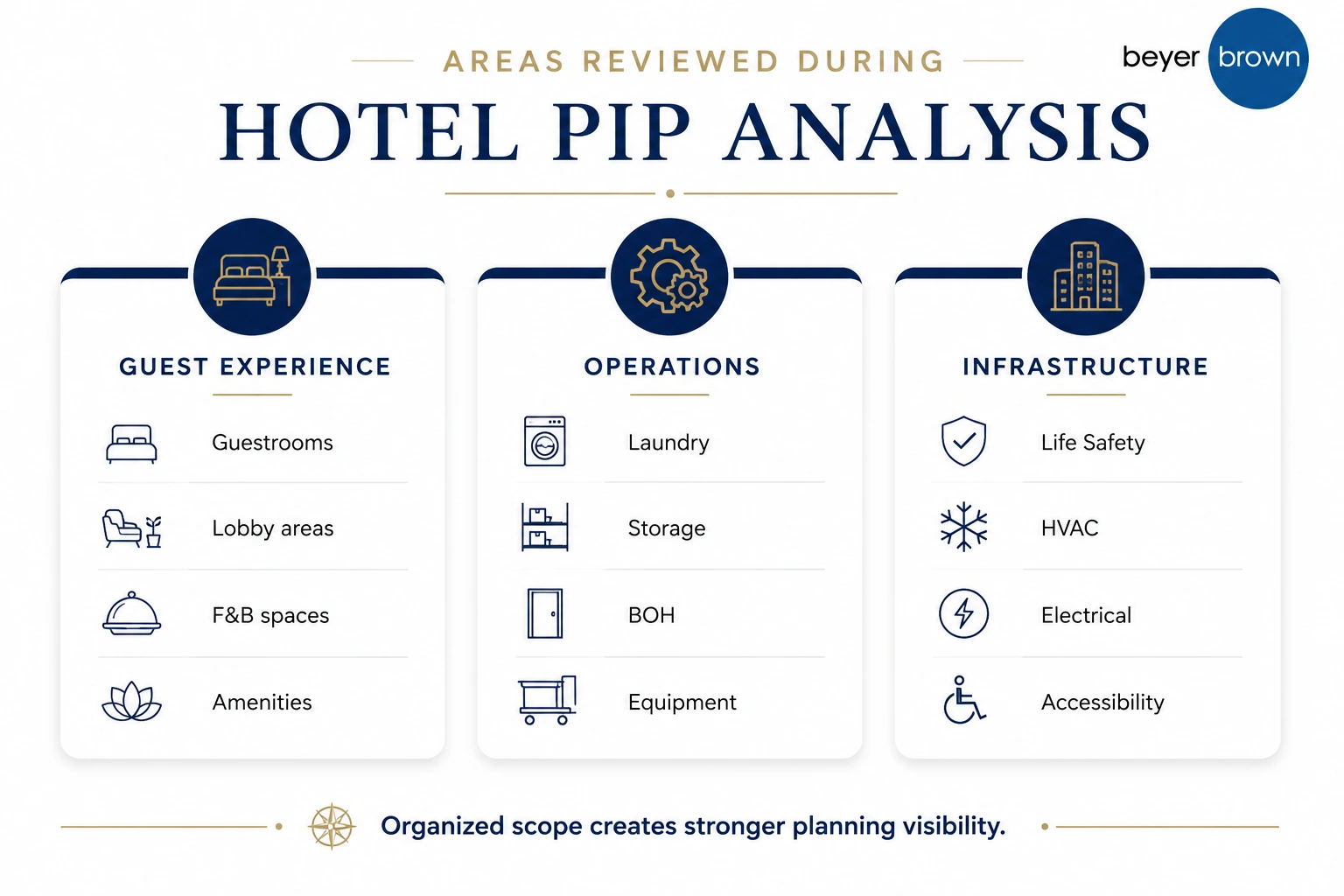
When Hotel PIP Analysis organizes scope across these categories, leadership teams gain clearer visibility into immediate investment needs, phased capital opportunities, operational dependencies, budget priorities, and procurement timing considerations. This visibility helps transform capital planning from broad estimation into a more structured decision making process.
Rather than reacting to scope as it appears, ownership teams gain the ability to prioritize improvements intentionally, align investments more effectively, and move projects forward with greater confidence.
How Beyer Brown Supports Hotel PIP Analysis Through Procurement Planning
Turning Scope Into an Actionable Strategy
A Property Improvement Plan provides information, but Hotel PIP Analysis creates understanding. While a PIP outlines required improvements, ownership teams still need visibility into how those requirements influence budgets, project sequencing, procurement schedules, approvals, and long term project goals.
Beyer Brown approaches Hotel PIP Analysis through the perspective of procurement planning and lifecycle coordination. The focus is not simply reviewing scope items individually. The objective is helping owners, developers, and project teams understand how project requirements connect to investment decisions, operational planning, and execution strategy.
The process begins by organizing scope into clearly defined workstreams that create structure across the project. Review areas may include guest room FF&E replacement, public space improvements, decorative lighting updates, window treatments, operational equipment requirements, brand standard revisions, compliance related items, quantity verification needs, and procurement dependencies that may influence scheduling.
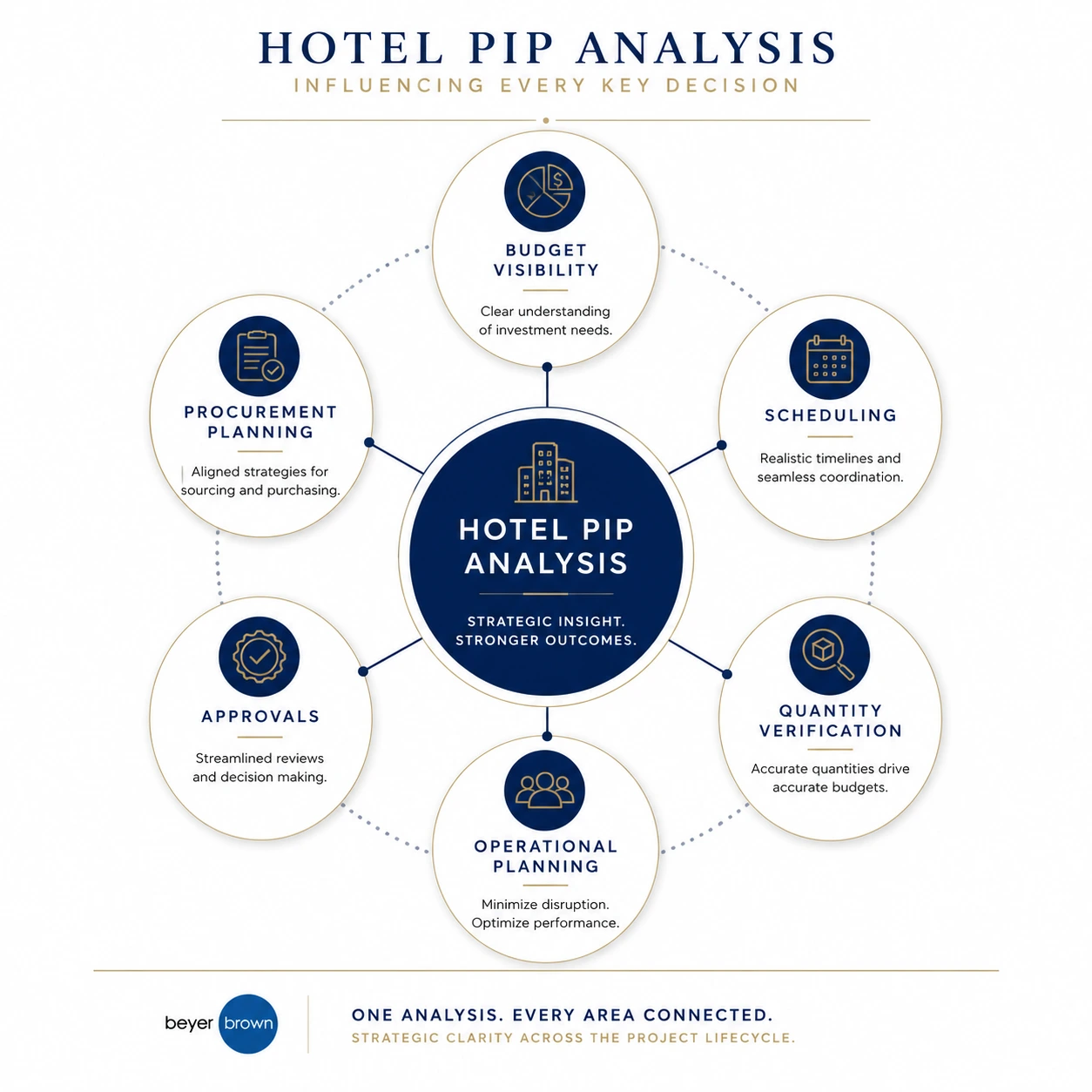
Each category is evaluated in relation to project timing, operational impact, procurement requirements, and capital planning considerations. This creates earlier visibility across the project and helps teams understand how individual decisions influence broader project outcomes.
Early scope visibility becomes particularly important because hospitality PIPs frequently contain overlapping requirements. Guestroom upgrades may affect procurement schedules and installation timing. Public space improvements often require phased execution strategies. Operational updates can influence occupancy planning, staffing considerations, and renovation sequencing. Understanding these relationships earlier helps reduce uncertainty and supports more coordinated decision making.
Clear scope definition also improves budget development. Rather than relying on broad renovation allowances, ownership teams gain a more detailed understanding of quantity impacts, procurement categories, phased investments, and project priorities. This supports stronger forecasting and creates more informed conversations around capital reserves, renovation timing, ownership approvals, brand coordination, and investment sequencing.
Procurement planning is another area where early visibility creates measurable value. Many hospitality projects encounter challenges when procurement discussions begin after scope decisions have already been established. Lead times, vendor coordination, specification review, freight planning, purchasing schedules, and installation timing all influence project outcomes.
Through Hotel PIP Analysis, procurement strategy develops alongside planning efforts rather than following them. This creates stronger continuity between scope evaluation, budgeting, procurement coordination, and execution.
The result is a more structured path forward where priorities are understood earlier, investment decisions gain clarity, and hospitality projects move toward implementation with greater alignment across teams.
How Hotel PIP Analysis Creates Planning Visibility
Organizing Scope Before Capital Decisions Move Forward
Once a Property Improvement Plan is issued, the next objective is not immediate execution. The first priority is understanding how project requirements influence investment decisions, operational planning, procurement timing, and long term asset goals. Hotel PIP Analysis creates that visibility by helping ownership teams organize scope before budgets are finalized and procurement activities begin.
The process typically starts by creating clarity around project scope. Rather than approaching the PIP as a single list of upgrades, requirements are organized into defined project categories that help teams understand where investment is concentrated and how improvements affect the broader project lifecycle.
Review areas may include guestrooms and suites, public spaces, amenity areas, food and beverage environments, meeting spaces, back of house functions, operational equipment requirements, compliance updates, and infrastructure improvements. This early organization helps ownership teams understand project scale, identify major investment areas, and create visibility before capital planning discussions move forward.
After scope is organized, attention shifts toward prioritization. Not every requirement carries the same level of impact. Some improvements directly influence guest experience and market positioning, while others support operations, compliance requirements, brand standards, infrastructure performance, or long term asset value.
Priority review often considers immediate brand requirements, operational needs, guest facing upgrades, compliance considerations, deferred opportunities, and future investment phases. Establishing these priorities earlier creates stronger alignment between project objectives and capital allocation decisions.
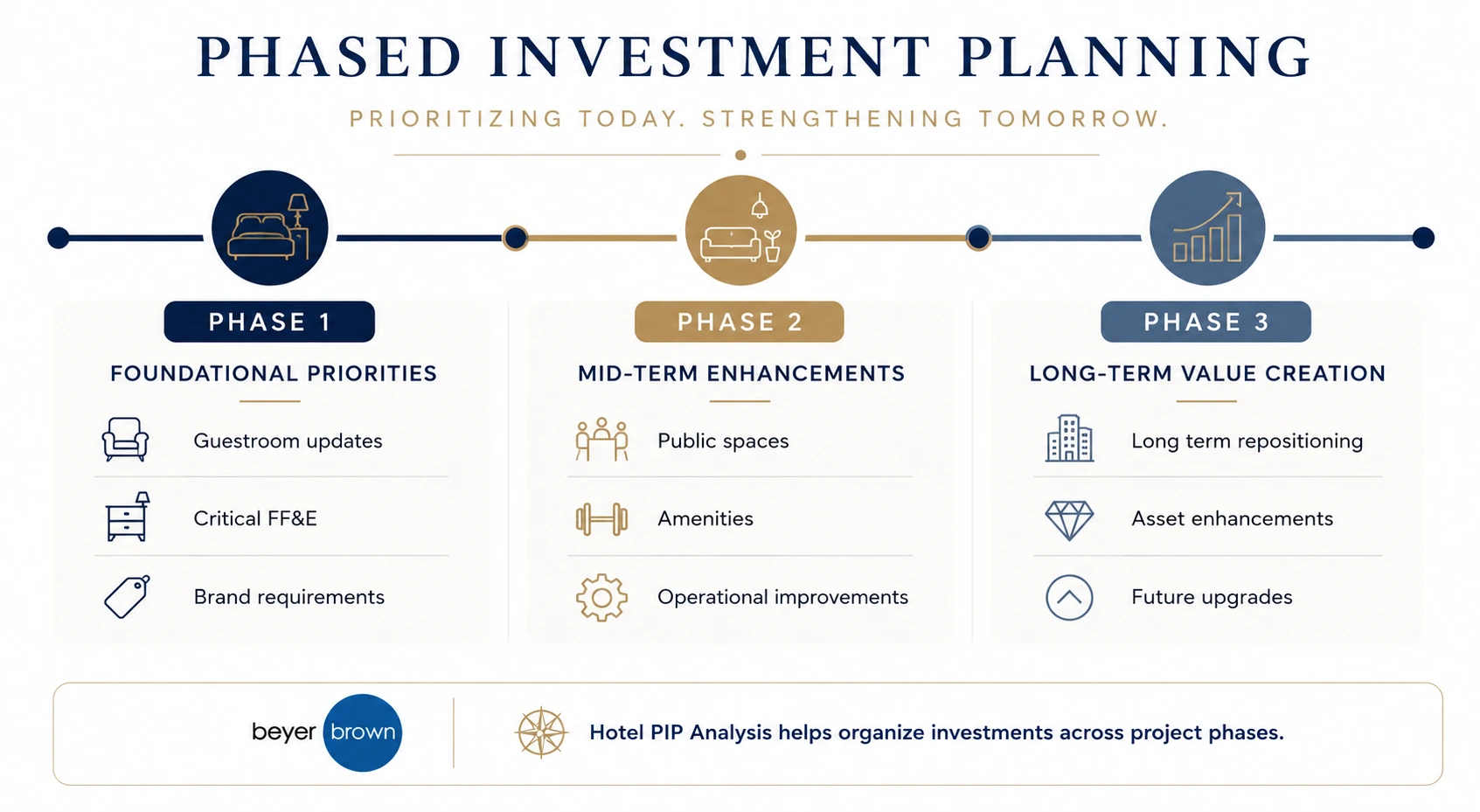
Clear scope visibility also supports more thoughtful budgeting conversations. Instead of viewing renovations as a single investment event, many hospitality projects benefit from phased planning approaches that balance immediate requirements with future improvements. This creates greater flexibility while maintaining visibility across budgets, schedules, and operational goals.
Early capital planning discussions may include immediate priorities such as guestroom updates, critical FF&E replacement, required brand improvements, and compliance related scope. Additional planning phases may focus on public space enhancements, amenity upgrades, operational refinements, and longer term repositioning opportunities that support future asset performance.
As priorities and budgets become more defined, procurement planning begins supporting execution. At this stage, Hotel PIP Analysis moves beyond review and becomes a coordination tool that helps align specifications, quantity verification, vendor engagement, lead time planning, purchasing schedules, and installation sequencing.
This creates continuity between early planning efforts and project execution. Rather than reacting to scope changes later in the process, ownership teams move forward with stronger visibility, clearer priorities, and a more coordinated path toward implementation.
Project Impact of Early Hotel PIP Analysis
Early Visibility Creates Better Long Term Outcomes
Hospitality projects become more manageable when planning begins with visibility. Hotel PIP Analysis helps create that visibility by giving ownership teams a clearer understanding of scope before procurement activities, budgeting discussions, and renovation decisions move forward. When priorities are established early, projects gain stronger alignment across planning, capital allocation, and execution.
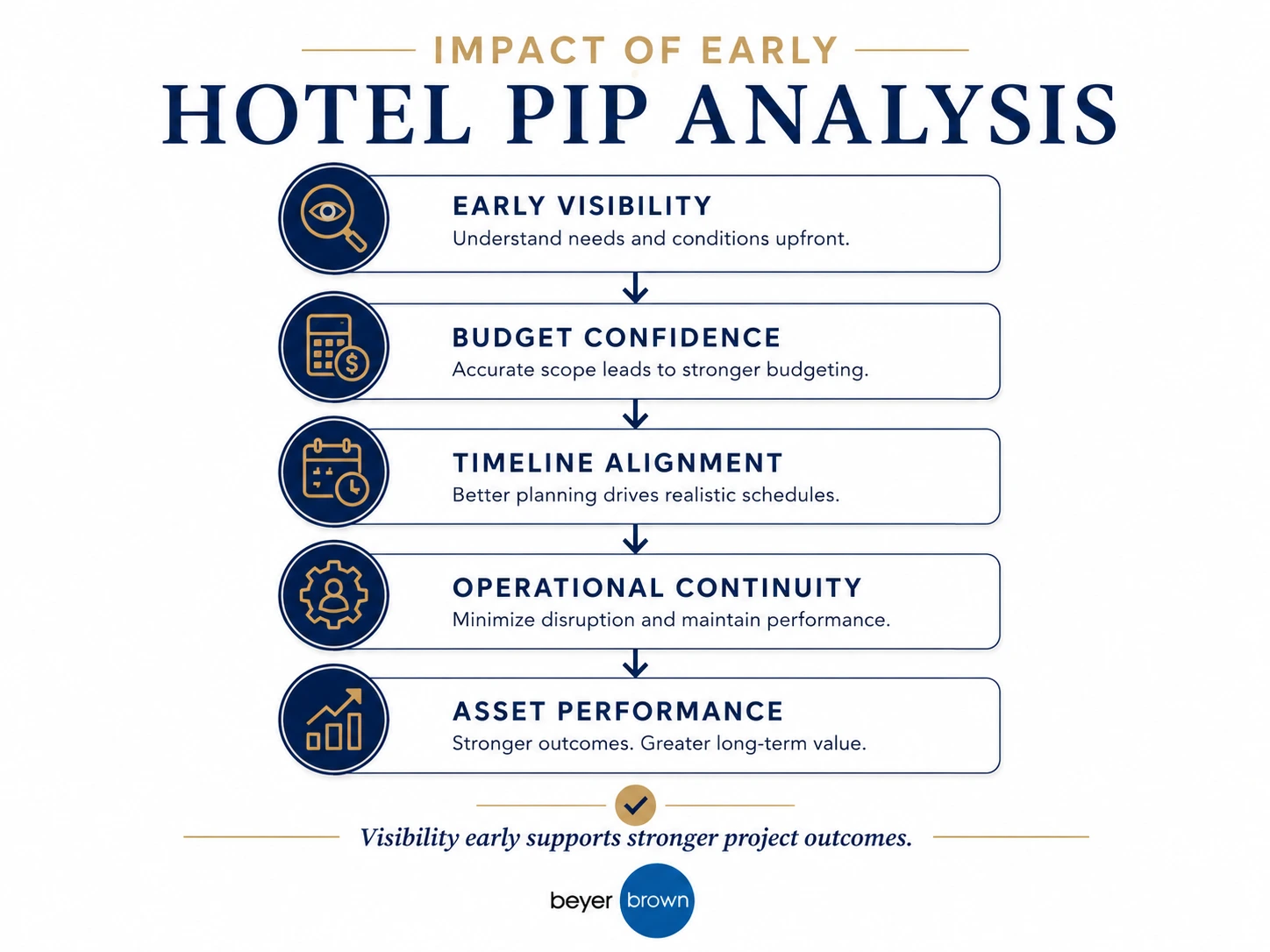
One of the earliest advantages is improved budget confidence. Clear scope definition supports more accurate forecasting and reduces uncertainty around future investment decisions. Instead of working with broad assumptions, teams can evaluate project requirements with greater precision and create budgets that reflect both immediate needs and longer term objectives.
Early visibility also strengthens timeline coordination. Prioritized scope allows teams to sequence work more effectively, understand dependencies earlier, and organize project phases with greater consistency. This creates better alignment across procurement schedules, approvals, operational planning, and installation readiness.
Operational continuity is another important consideration. Hospitality projects often require renovations to occur while maintaining guest experience standards and protecting occupancy goals. Thoughtful phasing strategies support this balance by helping teams organize work in ways that reduce disruption while maintaining day to day operations.
Hotel PIP Analysis also improves procurement coordination. Earlier understanding of project requirements helps align specifications, quantity verification, vendor engagement, purchasing schedules, and lead time planning before execution pressures increase. This creates stronger continuity between planning efforts and procurement activities throughout the project lifecycle.
Beyond immediate project needs, PIPs should support more than compliance requirements alone. They provide an opportunity to evaluate how current investments align with future asset performance, operational goals, guest experience expectations, and long term ownership strategy. Thoughtful capital planning helps teams balance required improvements with broader project objectives.
When visibility improves early, projects become less reactive. Decision making becomes more disciplined, procurement planning gains stronger alignment, and investment strategies move forward with greater intention and confidence.
Hotel PIP Analysis Creates Clarity Before Capital Is Committed
A Property Improvement Plan represents more than a list of required upgrades. It provides an opportunity to better understand the asset, organize project priorities, and align investment decisions with long term ownership goals. When approached strategically, Hotel PIP Analysis helps transform complex requirements into a clearer path forward for budgeting, planning, and execution.
Without structured review, scope can quickly become difficult to manage. Requirements may compete for attention, capital decisions can become reactive, and teams often move into budgeting before priorities are fully understood. Hotel PIP Analysis creates visibility earlier in the process, helping ownership teams establish clearer expectations around scope, investment timing, procurement planning, and phased execution strategies.
At Beyer Brown, PIP analysis supports owners, developers, and project teams by translating detailed requirements into organized planning frameworks that strengthen confidence across capital planning, procurement coordination, and project execution. The goal is not simply completing renovations or satisfying brand requirements. The focus is creating alignment, supporting thoughtful decision making, and helping projects move forward with greater clarity at every stage of the hospitality lifecycle.