


Hospitality preliminary budgeting often begins long before a hotel project has complete drawings, finalized specifications, or fully developed design documents. Owners and developers are frequently asked to evaluate project feasibility, establish investment expectations, secure financing, or determine whether a renovation, brand conversion, or new development aligns with their long term business objectives. At that stage, one of the most common questions is also one of the most important:
How much will this project realistically cost?
The answer depends on understanding the difference between hospitality preliminary budgeting and a detailed cost estimate. Although these terms are often used interchangeably, they represent two distinct stages of project planning. A preliminary budget establishes an informed financial direction using the information available early in the project, while a detailed cost estimate is developed later as drawings, specifications, quantities, and procurement decisions become more defined.
Confusing these two planning tools can create unrealistic expectations, unnecessary budget revisions, and difficult conversations as a project progresses. Understanding how each serves a different purpose allows owners, developers, designers, and operators to make better informed decisions while establishing realistic financial expectations throughout the planning process.
In hospitality, early budgets should never be viewed as educated guesses. Reliable hospitality preliminary budgeting draws upon procurement experience, historical project knowledge, current market conditions, anticipated FF&E and OS&E requirements, and an understanding of how hospitality projects evolve during design and construction. The goal is not to predict every future cost. The goal is to provide a financial framework that supports confident decision making while allowing the budget to mature alongside the project.
At Beyer Brown, hospitality preliminary budgeting is viewed as the first stage of procurement rather than a standalone financial exercise. Procurement professionals begin evaluating project scope, anticipated purchasing requirements, operational goals, and design intent early in the planning process, creating a stronger connection between budgeting, procurement strategy, and project execution. This integrated approach gives owners and developers greater visibility before purchasing decisions begin and establishes a more disciplined path toward successful project delivery.
Why Hospitality Preliminary Budgeting Matters to Owners and Developers
Hospitality projects begin long before every finish, fixture, and furnishing has been selected. During the earliest stages of planning, owners and developers are evaluating investment opportunities, establishing project goals, reviewing brand requirements, and determining how a project aligns with broader business objectives. Those decisions require financial direction well before complete drawings or final specifications are available.
Hospitality preliminary budgeting provides that direction.
Rather than waiting until every product has been specified, a preliminary budget establishes an informed financial outlook using the information available during early planning. Project scope, property type, historical procurement data, anticipated FF&E and OS&E requirements, current market conditions, and hospitality purchasing experience all contribute to developing a realistic budget that supports confident decision making.
For owners and developers, that early visibility influences decisions well beyond the budget itself. It helps determine whether a project is financially viable, establishes expectations for capital investment, informs conversations with lenders and investors, and creates a foundation for scheduling, design development, and operational planning.
Hospitality projects also evolve as planning progresses. Guestroom layouts may be refined. Public spaces may be redesigned to better reflect the property's positioning. Brand standards can introduce new requirements, and operational priorities may shift as additional information becomes available. A well-developed preliminary budget provides the flexibility to accommodate those changes while maintaining a clear financial direction throughout planning.
That flexibility is especially valuable during renovations, brand conversions, and Property Improvement Plans (PIPs), where existing building conditions, phased construction, and evolving brand requirements often influence project scope. Establishing realistic financial expectations early allows project teams to evaluate changes thoughtfully instead of reacting after purchasing decisions have already begun.
Hospitality Preliminary Budgeting vs. Detailed Cost Estimates
Although the two are closely connected, hospitality preliminary budgeting and detailed cost estimates serve different purposes throughout a project's planning and procurement process.
A hospitality preliminary budget establishes an informed financial framework during the earliest stages of planning. It provides owners and developers with the information needed to evaluate opportunities, define project direction, and make investment decisions before every specification has been finalized.
A detailed cost estimate is developed later as drawings become more complete, specifications are finalized, quantities are verified, and procurement strategies are established. Rather than replacing the preliminary budget, it builds upon that early framework by introducing greater detail and pricing precision.
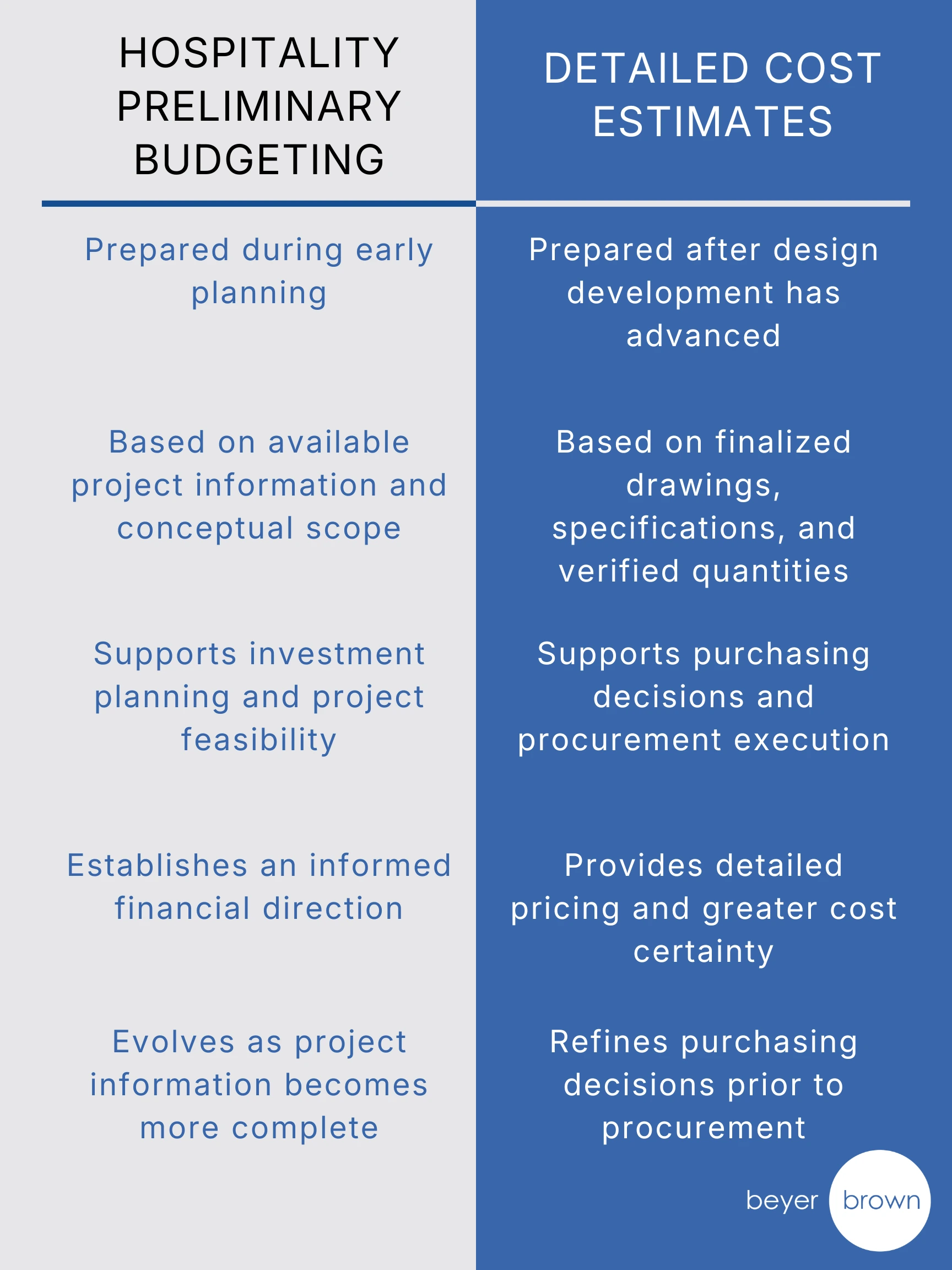
Understanding this distinction allows owners and developers to evaluate each stage of planning with appropriate expectations. Early budgets are intended to guide decision making, while detailed cost estimates provide the level of precision needed before purchasing begins. Expecting one document to perform the role of the other often leads to unnecessary revisions, unrealistic expectations, and avoidable budget concerns later in the project.
The strongest hospitality projects recognize that budgeting is not a single milestone. It is an evolving process that becomes more accurate as additional information is gathered, decisions are made, and procurement planning advances alongside design development.

How Procurement Strengthens Hospitality Preliminary Budgeting
Hospitality preliminary budgeting is most effective when procurement expertise is part of the conversation from the beginning. While preliminary budgets are developed before every product has been selected, they should never be created in isolation. Decisions made during early planning influence purchasing strategies, project schedules, installation sequencing, and long term operational performance long before procurement officially begins.
This is where hospitality procurement experience creates measurable value.
Procurement professionals evaluate more than anticipated costs. They understand how property type, project scope, brand standards, supplier capabilities, product availability, freight conditions, and installation requirements influence a project's overall financial direction. That perspective allows early budgets to reflect the realities of hospitality purchasing rather than relying solely on conceptual assumptions.
For owners and developers, this creates a stronger foundation for financial planning. Budget discussions are informed not only by design intent, but also by the practical considerations that will ultimately shape purchasing decisions, project coordination, and operational readiness.
At Beyer Brown, procurement planning begins alongside project planning. During the earliest stages of development, procurement professionals review available drawings, project scope, operational requirements, anticipated guestroom counts, public space programming, and preliminary specifications to establish realistic purchasing assumptions before detailed cost estimates are developed.
This early collaboration creates greater visibility into the factors that influence project costs while allowing financial planning and procurement strategy to progress together instead of independently.
One example is the evaluation of anticipated FF&E Procurement and OS&E Procurement requirements. Even before every product has been specified, experienced procurement teams can evaluate major purchasing categories, identify potential cost drivers, and develop realistic budgeting assumptions based on the project's scope, brand standards, and operational objectives.
As design development advances, those assumptions become more refined through specification reviews, supplier coordination, and quantity verification. Reviewing quantities early reduces the likelihood of ordering discrepancies while allowing budgets to evolve alongside the design rather than requiring significant adjustments later in the project.
Procurement experience also provides valuable insight into factors that are often overlooked during early budgeting conversations. Product lead times, freight strategies, warehousing requirements, phased installations, supplier availability, and brand compliance all influence purchasing decisions and can affect overall project costs. Evaluating these considerations early gives owners and developers a clearer understanding of the financial realities that may shape the project as planning progresses.
Perhaps most importantly, procurement connects financial planning with execution.
A preliminary budget should not exist as an isolated spreadsheet that is revisited only after design has been completed. It should serve as the foundation for purchasing strategies, supplier engagement, scheduling decisions, and installation planning throughout the project. When budgeting and procurement remain connected, financial decisions become more intentional because they are informed by the same operational realities that will guide project execution.
This philosophy reflects Beyer Brown's approach to hospitality procurement services. Procurement is not viewed as a single purchasing phase. It is a disciplined process of planning, coordination, communication, and financial stewardship that begins during project planning and continues through procurement, logistics, installation, and project closeout.
For hospitality owners and developers, this integrated approach provides more than a reliable budget. It creates clearer financial visibility, stronger coordination across project teams, and a procurement strategy that remains aligned with the project's goals as design decisions become purchasing decisions.

A reliable hospitality preliminary budget creates the financial direction for a project, but that direction only delivers value when it carries through the procurement process. As design decisions become specifications and specifications become purchasing decisions, every stage builds upon the planning completed at the beginning of the project. Understanding how those stages connect provides valuable insight into why procurement is viewed as a continuous process rather than a single phase of project delivery.
Hospitality Preliminary Budgeting Throughout the Procurement Process
Hospitality preliminary budgeting does not end once an initial budget has been approved. It becomes the financial reference point that guides procurement decisions as the project moves through design development, purchasing, logistics, installation, and ultimately project completion. Each stage introduces new information, allowing the budget to become more refined while maintaining alignment with the project's financial objectives.
Successful hospitality projects follow a disciplined process where budgeting and procurement evolve together rather than as separate activities. As drawings become more detailed, specifications are finalized, and purchasing requirements become clearer, procurement professionals continuously evaluate new information against the established budget to maintain visibility throughout the project.
For owners and developers, this coordinated approach creates greater transparency during every stage of planning. Financial decisions are no longer isolated moments in time. Instead, they become part of an ongoing process where design decisions, procurement strategy, scheduling, and purchasing remain connected.
The Hospitality Procurement Lifecycle
Every hospitality project follows its own unique path, but the overall procurement process remains remarkably consistent. Each phase builds upon the work completed during the previous stage, creating a structured approach that reduces uncertainty while supporting informed decision making throughout the project.
Project Vision
Every project begins with a vision for the property. Owners, developers, operators, and designers establish business goals, guest experience objectives, brand standards, operational requirements, and the overall scope of the renovation or development. These early conversations provide the direction that shapes every decision that follows.
Hospitality Preliminary Budgeting
Once the project vision has been established, hospitality preliminary budgeting provides the first financial benchmark. Procurement professionals evaluate the available project information, anticipated FF&E and OS&E requirements, historical purchasing data, property type, and conceptual scope to establish realistic budget expectations before detailed specifications are available.
Design Development
As architects and interior designers continue refining the project, additional details become available. Guestroom layouts, public spaces, lighting packages, casegoods, seating, millwork, finishes, and operational requirements all become more clearly defined. Each design milestone provides procurement teams with new information that allows budgeting assumptions to become more accurate.
Detailed Cost Estimates
As specifications mature and quantities are verified, preliminary budgets transition into detailed cost estimates. Supplier pricing, specification reviews, verified quantities, and current market conditions create a more detailed financial picture that supports purchasing decisions while remaining aligned with the project's established budget objectives.
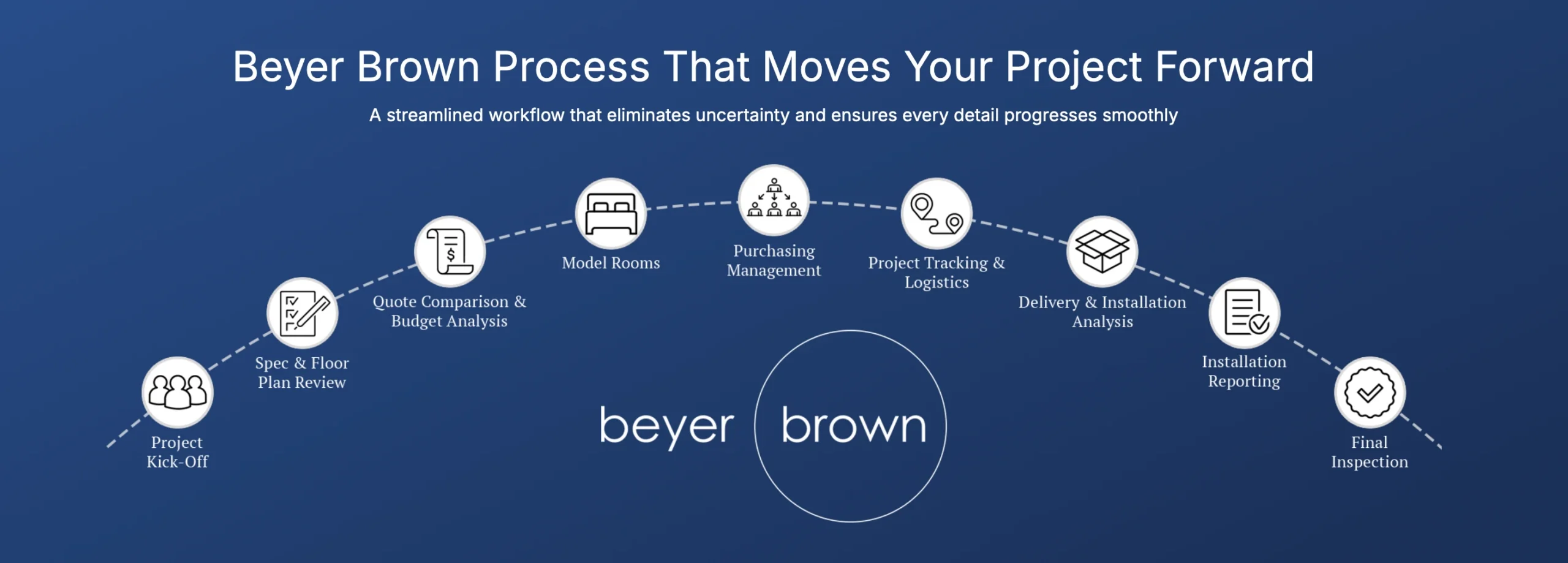
The procurement lifecycle illustrates an important principle within hospitality development: budgeting is not a document that sits on a shelf after early planning has been completed. It remains an active part of the procurement process as new information becomes available and project decisions continue to shape purchasing strategies.
At Beyer Brown, procurement professionals continually compare evolving project information against the established budget. Specification revisions, supplier recommendations, quantity updates, freight considerations, installation sequencing, and scheduling adjustments are all evaluated within the context of the project's financial objectives. This ongoing coordination provides owners and developers with greater visibility as the project advances while reducing the likelihood of unexpected budget challenges later in procurement.
The value of this process extends beyond purchasing. Coordinated procurement creates stronger communication between owners, designers, manufacturers, contractors, and installation teams because everyone is working from the same project objectives. Design intent remains connected to financial expectations, procurement decisions reflect operational priorities, and project milestones remain coordinated throughout execution.
Hospitality projects rarely progress exactly as originally envisioned. Existing building conditions may introduce unforeseen challenges during a renovation. Brand standards may evolve during design development. Product availability may require specification adjustments, and construction schedules may shift as work progresses. A disciplined procurement process provides the structure needed to evaluate these changes thoughtfully while maintaining alignment with the project's financial goals and overall vision.
This level of coordination is one of the reasons procurement should be involved long before purchasing begins. By integrating budgeting, procurement strategy, logistics planning, supplier coordination, and installation planning into a single process, project teams are able to make informed decisions throughout the project rather than reacting to issues after they occur.
The Long Term Impact of Hospitality Preliminary Budgeting
Hospitality preliminary budgeting influences far more than the early planning stages of a project. Decisions made before final specifications are completed often shape purchasing strategies, project schedules, financial planning, installation coordination, and operational readiness months later. A disciplined budgeting process creates continuity throughout the project, allowing each phase to build upon informed decisions rather than requiring teams to continually revisit earlier assumptions.
For owners and developers, one of the greatest advantages is financial clarity. Establishing realistic budget expectations early allows investment decisions to be made with a stronger understanding of project scope, anticipated procurement requirements, and overall capital needs. As additional information becomes available, budgets become more refined without changing the project's overall financial direction.
This level of visibility also creates better coordination across the entire project team. Architects, interior designers, operators, contractors, manufacturers, and procurement professionals are able to make decisions using a shared understanding of the project's priorities and financial objectives. When those conversations remain aligned throughout planning and procurement, the project is better positioned to maintain momentum while reducing unnecessary revisions and last minute decision making.
Hospitality preliminary budgeting also creates opportunities for more thoughtful purchasing strategies. Procurement professionals can evaluate supplier options, coordinate product availability, anticipate lead times, and prepare installation schedules before purchasing begins. Rather than reacting to changing project conditions, teams can make informed adjustments that support both the design vision and the project's financial objectives.
For hospitality properties preparing for a renovation, brand conversion, Property Improvement Plan (PIP), or new development, this coordinated approach helps protect more than the budget. It supports project schedules, preserves design intent, and improves communication across every organization involved in delivering the finished environment. These advantages become especially valuable on large, multi phase projects where even small decisions can influence procurement, logistics, and installation months later.
At Beyer Brown, hospitality preliminary budgeting is approached as the foundation for disciplined procurement rather than a standalone financial exercise. Early planning, procurement strategy, quantity verification, supplier coordination, logistics planning, and installation management all build upon the financial framework established during the earliest stages of the project. This integrated approach allows procurement decisions to remain aligned with the project's business goals while creating greater visibility throughout execution.
Ultimately, successful hospitality projects are not defined by a single budget meeting or purchasing decision. They are the result of consistent planning, thoughtful coordination, and informed decision making carried through every phase of development. When hospitality preliminary budgeting is supported by experienced procurement professionals, owners and developers gain more than an early estimate. They gain a structured decision making process that provides financial clarity, strengthens coordination, and establishes a stronger foundation for successful project delivery.

Hospitality preliminary budgeting is much more than an early financial estimate. It establishes the financial direction that guides planning, design development, procurement, logistics, and installation throughout the life of a project. When approached with realistic expectations and informed by hospitality procurement expertise, it provides owners and developers with the clarity needed to make confident decisions long before purchasing begins.
As projects evolve, preliminary budgets naturally become more refined through detailed cost estimates, verified quantities, finalized specifications, and supplier pricing. This progression is expected and reflects the increasing level of information available as planning advances. Recognizing the purpose of each stage allows project teams to evaluate financial decisions within the appropriate context while maintaining realistic expectations throughout the project.
Successful hospitality projects are built on coordinated decision making. Financial planning, design intent, procurement strategy, supplier coordination, logistics, and installation are all interconnected. When these elements remain aligned, projects move forward with greater visibility, stronger communication, and a more structured approach to managing complexity.
At Beyer Brown, hospitality preliminary budgeting is approached as the first stage of a comprehensive procurement strategy. Procurement professionals engage early to evaluate project scope, anticipated purchasing requirements, operational priorities, and design intent, allowing financial planning to develop alongside the project itself. This collaborative process provides owners, developers, designers, and operators with meaningful insight before purchasing decisions are made, creating a stronger foundation for every phase that follows.
Hospitality environments are shaped by thousands of decisions made long before guests walk through the front door. The most successful projects are rarely the result of a single purchasing decision or one well managed installation. They are the outcome of disciplined planning, experienced procurement, and consistent coordination across every stage of development.
Hospitality preliminary budgeting creates the framework for those decisions. Procurement transforms that framework into a coordinated strategy. Together, they establish a clear path toward projects that reflect the original design vision, support operational goals, and deliver long term value for owners, developers, and hospitality brands.
Hospitality preliminary budgeting creates the framework for those decisions. Hospitality procurement services transform that framework into a coordinated strategy, creating a clear path toward projects that reflect the original design vision, support operational goals, and deliver long term value for owners, developers, and hospitality brands.