


Why Revisions and Re Approvals Create Risk in Hospitality Projects
Hospitality projects depend on coordination across ownership groups, designers, operators, procurement teams, brand representatives, vendors, and contractors. Every decision connected to furnishings, finishes, fixtures, and operational requirements influences budget visibility, installation sequencing, and opening readiness.
When specifications are incomplete, unclear, or misaligned early in the process, revisions often continue throughout the project lifecycle. Product substitutions, quantity discrepancies, missing details, and approval inconsistencies can create repeated review cycles that impact timelines and introduce unnecessary uncertainty.
For owners and developers, revisions rarely affect only one area of the project. A single specification adjustment can influence procurement schedules, freight coordination, installation sequencing, operational planning, and overall project alignment. Re approvals also place additional pressure on internal teams that are already managing multiple moving parts across development and construction.
This is why specification assistance plays an important role in hospitality procurement. Structured specification coordination helps teams establish clarity earlier, reduce avoidable revisions, and create more consistent alignment across stakeholders before purchasing begins.
At Beyer Brown, specification assistance is approached as part of a broader procurement strategy focused on coordination, visibility, and lifecycle execution. The goal is not simply to review product information. The goal is to support confident decision making, clearer approvals, and stronger project continuity across the full hospitality development process.

Why Specification Clarity Matters to Owners and Developers
In hospitality development, approvals are tied closely to timing, financial visibility, operational planning, and brand consistency. When specifications lack clarity, teams often spend additional time revisiting decisions that should have been finalized earlier in the project lifecycle.
This creates challenges that extend well beyond documentation.
For owners and developers, repeated revisions can affect:
-
Procurement schedules
-
Budget forecasting
-
Vendor coordination
-
Freight planning
-
Installation sequencing
-
Brand compliance
-
Opening readiness
When specifications continue changing after procurement activities begin, teams may need to revisit approvals, reissue pricing requests, update quantities, or coordinate substitute products. These adjustments can create delays that impact multiple project phases simultaneously.
In hospitality environments, specification clarity is especially important because projects involve a high volume of interconnected decisions. Guest room furniture, decorative lighting, seating, finishes, window treatments, operating supplies, and accessories all need to align across design intent, operational functionality, brand standards, and procurement realities.
Without structured coordination, even small inconsistencies can create larger downstream issues.
For example, a decorative lighting specification may initially appear approved, but later revisions to dimensions or finishes could affect production timelines, freight coordination, or installation requirements. Similarly, unclear furniture specifications may lead to vendor questions, approval delays, or inconsistencies between quoted products and final project expectations.
This is why early specification coordination matters.
Clear specifications help create:
-
More accurate budgeting visibility
-
Stronger vendor communication
-
Faster approval workflows
-
Better alignment between stakeholders
-
Fewer procurement disruptions
-
Greater confidence during execution
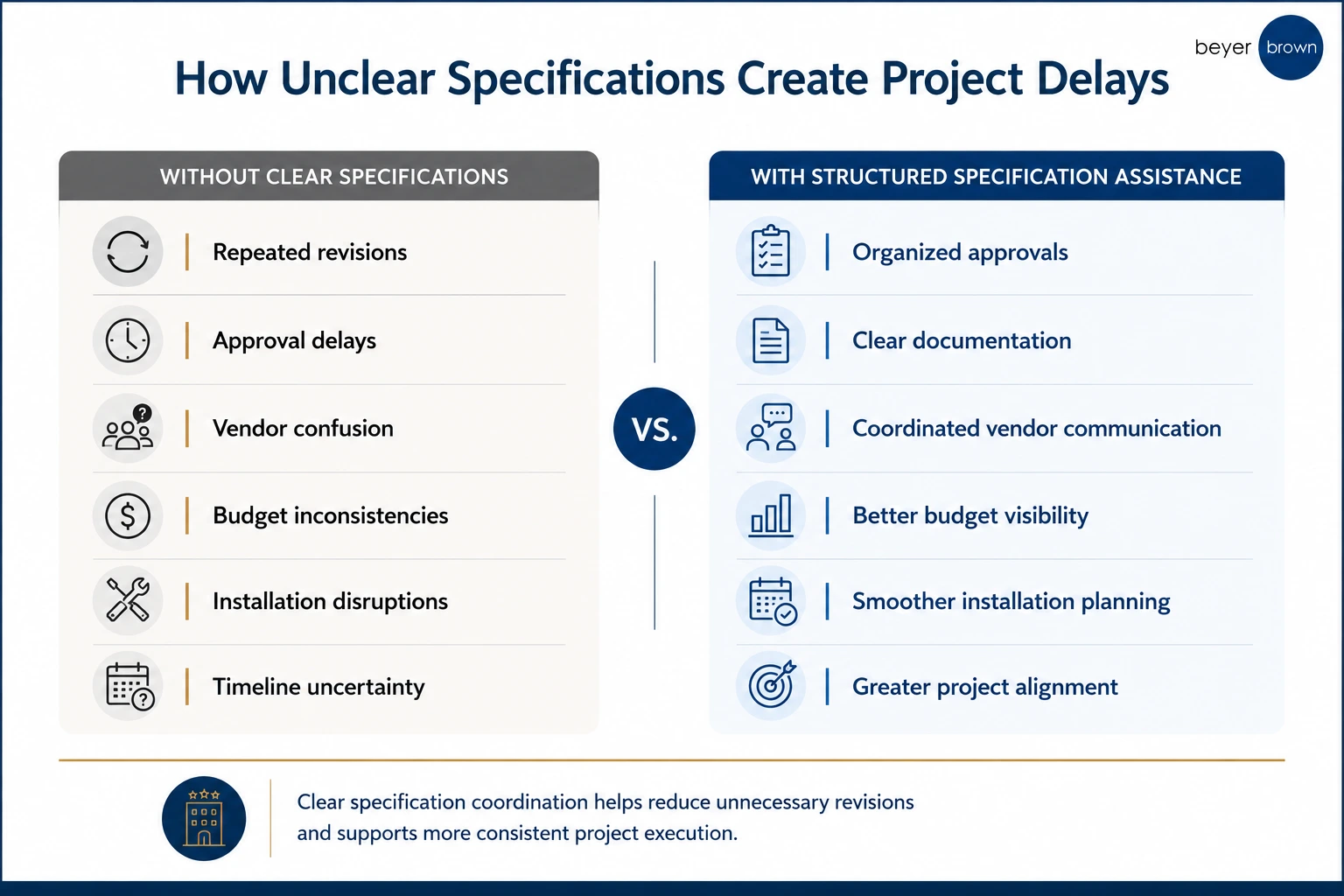
Specification assistance also supports more informed decision making for ownership groups. When documentation is organized and clearly communicated, teams can evaluate scope, pricing, timelines, and operational implications with greater confidence.
This level of clarity becomes increasingly important in hospitality projects involving renovations, phased openings, multi property portfolios, or projects with multiple stakeholder groups.
Projects move more consistently when teams spend less time revisiting decisions and more time advancing coordinated execution.
How Beyer Brown Supports Specification Coordination Through Procurement
Specification assistance is most effective when it is integrated into a broader procurement strategy rather than treated as a standalone administrative task.
At Beyer Brown, specification coordination is approached through the lens of hospitality procurement execution. The process focuses on creating alignment between design intent, operational requirements, budgeting visibility, procurement timelines, and vendor coordination.
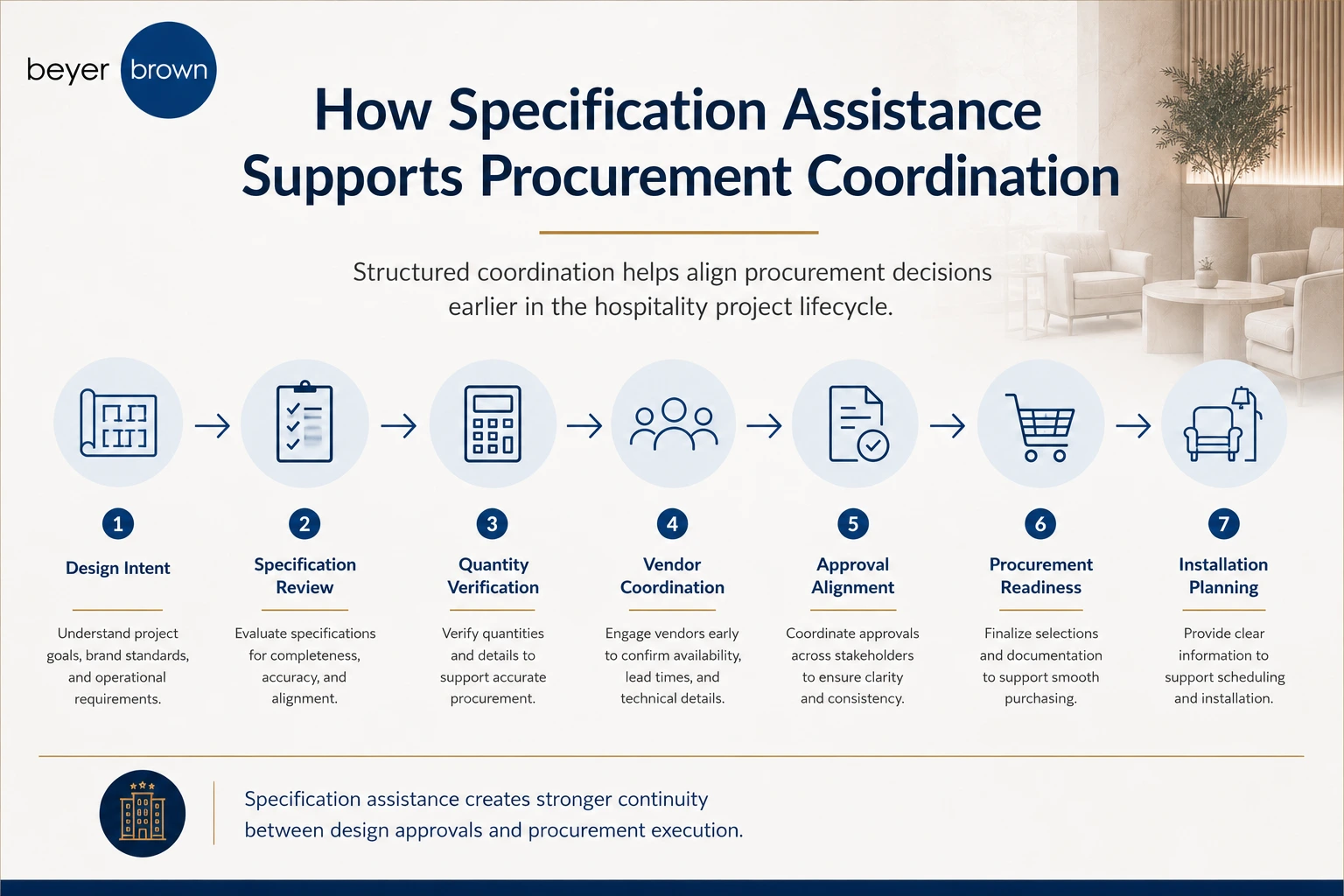
This structured approach helps reduce uncertainty before OS&E purchasing begins.
Rather than waiting for issues to appear later in the project lifecycle, procurement teams work proactively to identify inconsistencies, clarify details, coordinate approvals, and support communication across stakeholders early in the process.
Specification assistance may include:
-
Reviewing specification documentation for completeness
-
Coordinating product details with vendors and design teams
-
Identifying missing or inconsistent information
-
Supporting quantity verification processes
-
Clarifying finish selections and product applications
-
Assisting with budget alignment discussions
-
Coordinating substitutions when necessary
-
Organizing procurement documentation for approvals
This process creates stronger continuity between specification development and procurement execution.
In hospitality projects, procurement teams often operate at the intersection of design, operations, logistics, and ownership expectations. Because of this, structured specification coordination helps teams evaluate not only aesthetic intent, but also operational practicality, lead times, freight implications, installation sequencing, and overall project feasibility.
This broader perspective helps reduce situations where approved products later require changes due to budget limitations, production concerns, or operational conflicts.
Specification assistance also helps improve communication efficiency across project teams. When documentation is clearly organized and procurement information is aligned early, vendors can provide more accurate pricing and lead time information while ownership teams gain better visibility into project scope and purchasing requirements.
This creates a more predictable procurement environment.
For hospitality developers and ownership groups, predictability matters because procurement delays often influence broader project schedules. Coordinated specification processes help reduce unnecessary disruptions while supporting smoother transitions between design approvals, purchasing activities, and installation planning.
Hospitality projects involve constant coordination between multiple moving parts. Structured specification assistance helps support that coordination through clarity, organization, and disciplined execution.
What the Specification Assistance Process Looks Like in Hospitality Procurement
Specification coordination is not a single review stage. It is an ongoing process that supports alignment across procurement planning, approvals, purchasing activities, and project execution.
In hospitality procurement, the specification assistance process typically begins with reviewing project documentation to evaluate scope clarity, specification completeness, and procurement readiness.
This may include reviewing:
-
Furniture specifications
-
Finish schedules
-
Decorative lighting packages
-
Window treatment details
-
Guest room accessories
-
Public area requirements
-
Brand standards documentation
-
Operational requirements
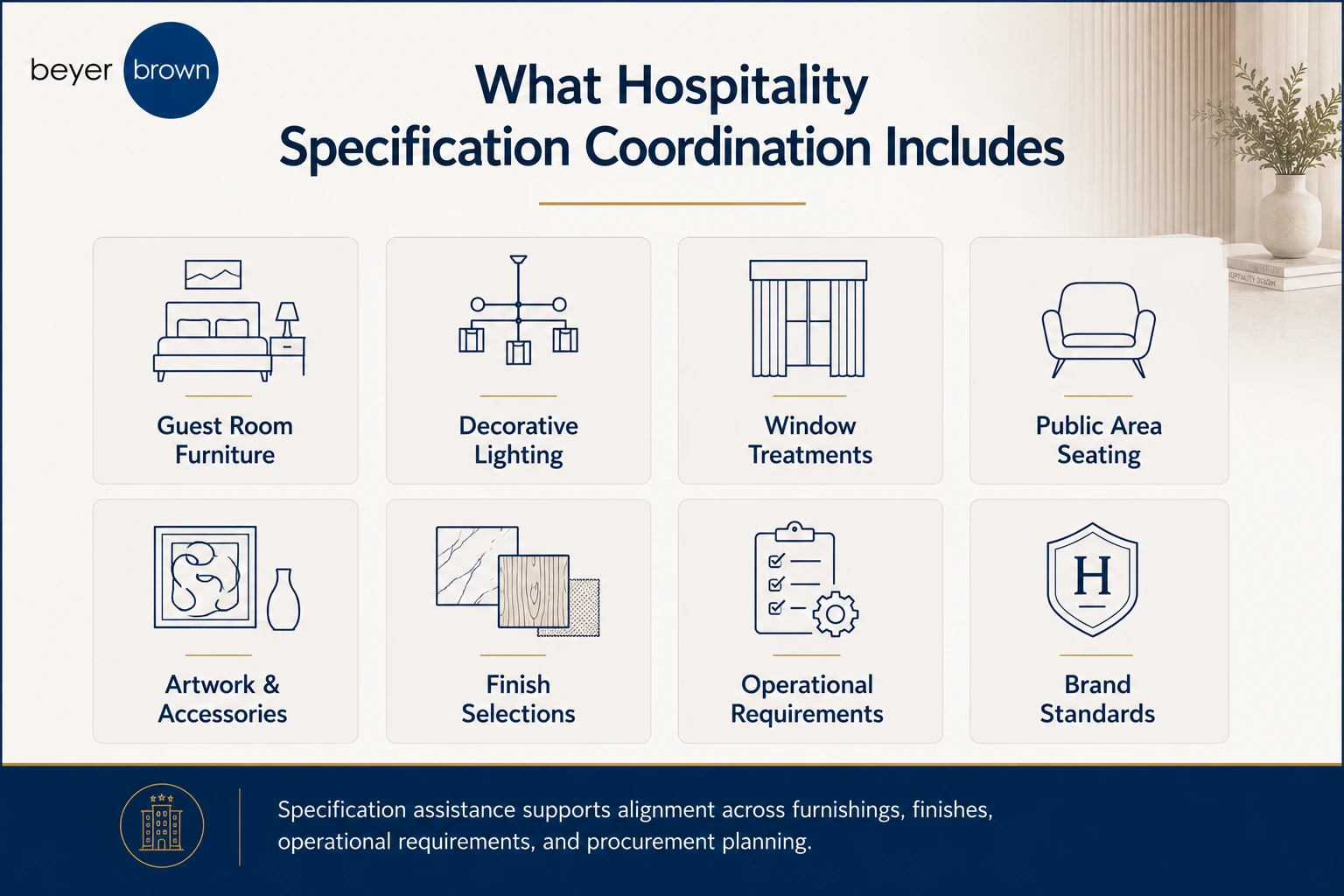
At this stage, procurement teams work to identify areas that may create future revisions or approval delays. This can include incomplete specifications, inconsistent quantities, unclear dimensions, discontinued products, missing finish information, or coordination gaps between design documentation and operational requirements.
Once documentation has been reviewed, teams coordinate with designers, vendors, ownership representatives, and operational stakeholders to clarify information and support alignment before purchasing begins.
This coordination process helps establish:
-
Clear product expectations
-
Consistent documentation standards
-
Organized approval workflows
-
Procurement visibility
-
Better vendor communication
-
Stronger quantity accuracy
As procurement planning progresses, specification assistance continues supporting project continuity through ongoing coordination and documentation management.
If revisions become necessary, structured processes help teams evaluate how adjustments may influence:
-
Budget alignment
-
Lead times
-
Freight coordination
-
Installation sequencing
-
Brand compliance
-
Operational functionality
This level of visibility helps reduce reactive decision making later in the project lifecycle.
Specification assistance also supports procurement reporting and approval organization. Hospitality projects often involve multiple ownership groups, consultants, brand representatives, and operational stakeholders reviewing selections throughout the project timeline, particularly during PIP analysis and reporting initiatives and renovation planning.
Organized documentation helps simplify communication and reduce confusion during these review cycles.
When specification coordination is approached proactively, teams can often reduce repeated approval loops that create unnecessary delays during procurement and installation phases.
This process ultimately supports smoother project progression because decisions are documented clearly, communicated consistently, and aligned more effectively before execution advances.
The Project Impact of Reducing Revisions and Re Approvals
Reducing revisions is not simply about efficiency. It is about creating greater consistency, confidence, and predictability throughout the hospitality project lifecycle.
When specifications are coordinated clearly and approvals are aligned earlier, projects typically experience stronger continuity across procurement, logistics, installation, and operational preparation.
For ownership groups and developers, this can support:
-
More stable procurement timelines
-
Improved budget visibility
-
Better coordination across vendors
-
Reduced approval bottlenecks
-
Fewer installation disruptions
-
Stronger operational readiness
Projects also benefit from improved communication consistency across teams. Clear specifications help reduce situations where vendors, contractors, procurement teams, and operational stakeholders are working with conflicting or incomplete information.
This creates a more coordinated project environment.
In hospitality development, timing is closely connected to revenue planning, guest readiness, staffing coordination, and operational preparation. Procurement disruptions caused by repeated revisions can place additional pressure on teams attempting to maintain opening schedules and project continuity.
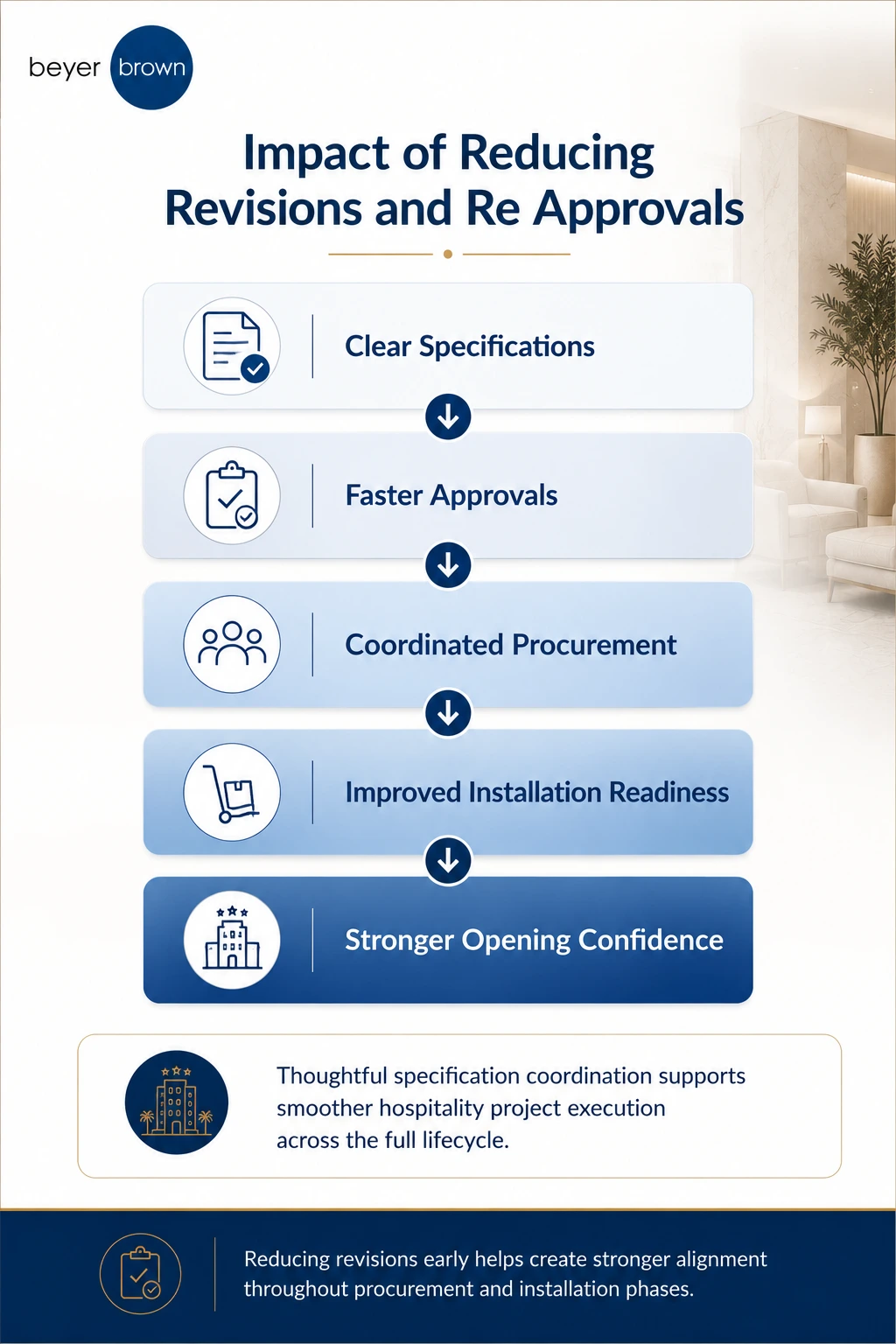
Specification assistance helps reduce that pressure by supporting earlier alignment and more disciplined coordination.
This becomes especially valuable in projects involving:
-
Renovations with active operations
-
Multi property rollouts
-
Brand conversion projects
-
Complex guest room programs
-
Large public area installations
-
Tight opening schedules
Structured specification coordination also supports long term project confidence. Ownership groups gain better visibility into purchasing activities, approval progress, and procurement planning while project teams operate with clearer documentation standards and more organized communication processes.
The result is not simply fewer revisions.
The result is a more coordinated procurement environment that supports smoother execution across the full hospitality project lifecycle.
Specification Assistance as a Strategic Procurement Function
Hospitality procurement requires more than purchasing coordination. It requires structure, visibility, communication, and disciplined execution across every stage of the project lifecycle.
Specification assistance plays an important role in supporting that structure.
When specifications are coordinated clearly and approvals are aligned early, teams can reduce unnecessary revisions, improve procurement continuity, and create stronger alignment between ownership goals, operational requirements, and project execution.
For owners and developers, this creates greater confidence throughout the project process. Clear documentation, organized approvals, and coordinated procurement planning help reduce uncertainty while supporting more predictable timelines and smoother project progression.
At Beyer Brown, specification assistance is approached as part of a broader hospitality procurement strategy focused on clarity, coordination, and long term partnership. The objective is not simply to manage documentation. The objective is to support thoughtful execution that protects project alignment, strengthens communication, and helps hospitality teams move forward with greater confidence.
In hospitality development, thoughtful coordination early in the process often creates stronger operational, financial, and procurement outcomes later in the project lifecycle.