

The Strategic Decision Behind Procurement Structure
The question of FF&E procurement versus direct purchasing surfaces early in hospitality projects. Owners and developers evaluating renovation or new development budgets often ask whether professional procurement is necessary. If vendor relationships already exist, or internal teams have purchasing experience, direct sourcing can appear efficient.
However, in hospitality, FF&E procurement is not simply a purchasing function. It is a structured risk management discipline that protects capital, schedule, compliance, and operational readiness.
When evaluating FF&E procurement versus direct purchasing, the true comparison is not fee versus no fee. It is structured lifecycle oversight versus fragmented coordination.
In hospitality environments, where brand standards, construction timelines, freight complexity, and phased installations intersect, that distinction becomes critical.

Key Considerations for Owners
When evaluating FF&E procurement versus direct purchasing, the decision extends well beyond vendor pricing. Procurement structure can influence several critical aspects of a hospitality project, including financial stability, schedule coordination, and operational readiness.
Owners and developers should carefully consider how procurement strategy affects capital predictability, brand compliance requirements, freight and logistics coordination, installation sequencing, and the long term performance of the asset. Understanding how these factors interact within the broader project lifecycle helps owners determine which procurement structure best supports their renovation or development objectives.
Why FF&E Procurement vs Direct Purchasing Matters to Owners
For owners and asset managers evaluating FF&E procurement versus direct purchasing, the decision influences far more than vendor pricing. Procurement structure directly affects capital predictability, schedule stability, lender reporting confidence, brand approval timelines, freight coordination, installation efficiency, and the long-term durability of the asset.
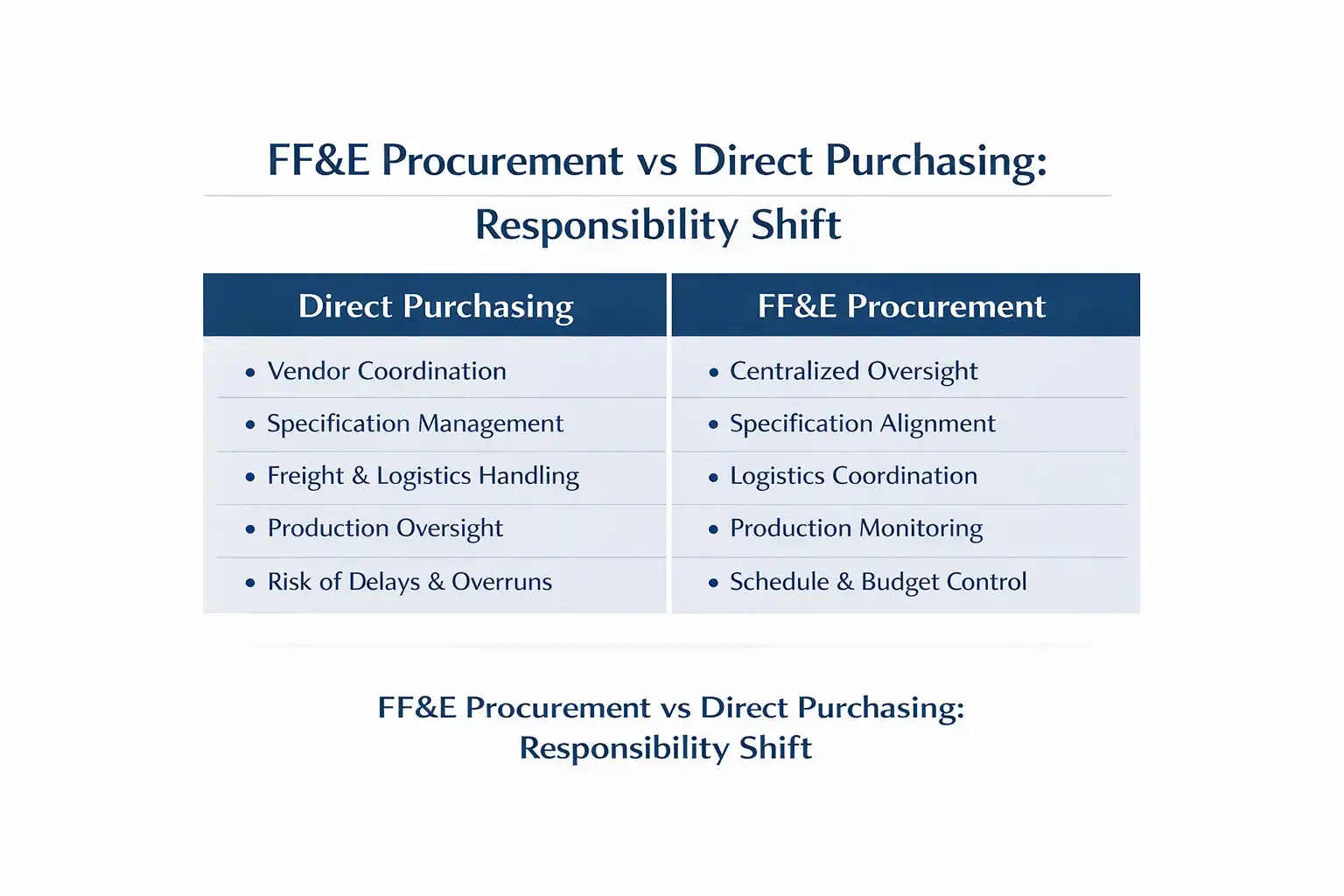
When procurement is removed and direct purchasing is adopted, responsibility does not disappear. It shifts inward. Internal teams must interpret specifications, coordinate vendor agreements, monitor production progress, plan logistics, manage storage and freight claims, and align deliveries with installation sequencing.
In smaller or highly controlled project scopes, this level of coordination may appear manageable. In hospitality renovation environments, however, the complexity quickly expands. Projects driven by brand mandated Property Improvement Plans introduce strict timelines, specification requirements, and approval checkpoints that must remain aligned throughout design, procurement, and construction.
For owners managing complex capital structures that include senior debt, mezzanine financing, or investor equity, disruptions in procurement can influence far more than construction progress. Delays may affect draw schedules, increase interest carry, and extend the timeline required to stabilize the asset.
This is where the distinction between FF&E procurement and direct purchasing becomes strategic rather than operational. The procurement structure chosen at the outset of a project plays a significant role in how predictably a renovation progresses and how confidently the asset moves toward opening and long-term performance.
The Impact on Capital Stack and Financial Stability
Hospitality projects operate within structured capital frameworks. Loan agreements often require milestone verification before funds are released, and construction draws depend on confirmed project progress. When renovation timelines shift, the effects extend beyond construction activity. Delays can increase interest carry, disrupt draw schedules, and extend the time required for the asset to reach stabilization.
In direct purchasing models, fragmented vendor oversight can introduce financial variability. Deposit schedules may fall out of alignment with construction milestones, payment timing may conflict with production progress, and manufacturing delays can trigger freight surcharges, expedited shipping costs, or reorders caused by quantity discrepancies. As these variables accumulate, contingency reserves can compress quickly and budget stability becomes more difficult to maintain.
Structured hotel FF&E procurement introduces financial coordination much earlier in the project lifecycle. Quantity verification, production aligned payment scheduling, and disciplined cost tracking help ensure procurement activity remains aligned with the broader financial strategy of the renovation.
Rather than reacting to vendor updates as they occur, lifecycle procurement anticipates production timelines and aligns them with construction sequencing. This coordination supports more stable draw schedules, improves the reliability of budget approvals, strengthens investor reporting confidence, and allows financial forecasts to remain more accurate throughout the renovation.
For owners managing complex capital structures, predictability often carries greater value than the nominal savings that may appear achievable through direct purchasing. A coordinated procurement strategy helps ensure that purchasing decisions remain aligned with both the financial structure of the project and the long-term performance of the asset.
Freight Exposure and Logistics Complexity
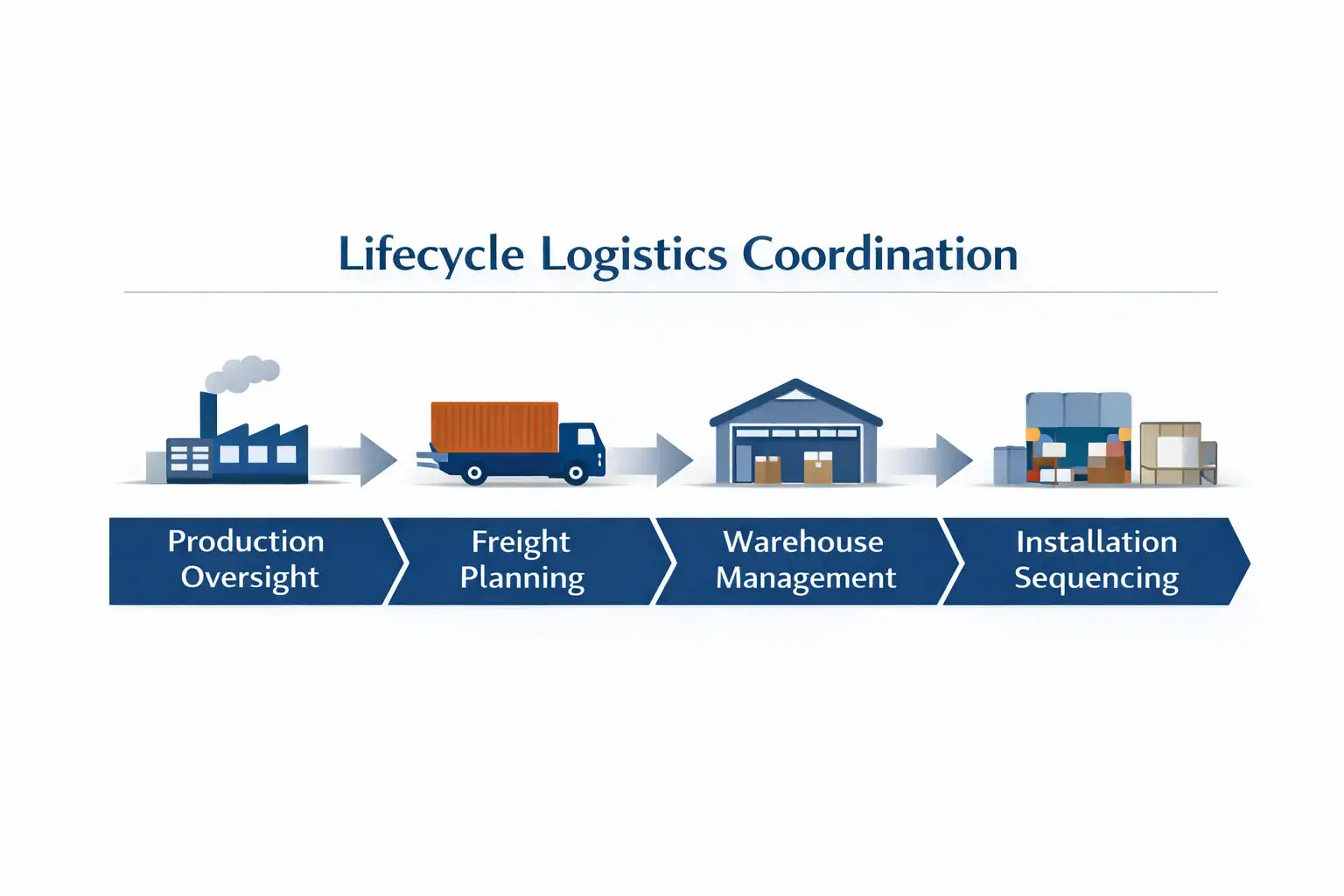
In hospitality projects, the distinction between FF&E procurement and direct purchasing often becomes most visible in logistics planning. When freight coordination is integrated into the procurement lifecycle, installation timelines become far more predictable.
Freight is one of the most underestimated risk categories in the FF&E procurement versus direct purchasing conversation. Hospitality renovations rarely involve a single manufacturer. A typical project may require casegoods produced by one vendor, seating manufactured by another, lighting fixtures sourced through multiple suppliers, decorative elements produced internationally, custom millwork, and soft goods developed across staggered production schedules. As these items move through production, each shipment introduces its own logistical variables. For owners and developers, these details directly influence installation sequencing, project timelines, and the overall stability of the renovation schedule.
Freight classification, fuel surcharges, port congestion, customs documentation, lift gate requirements, site access limitations, storage timing, and inspection protocols all influence how goods move from manufacturing facilities to the property. When these variables are not coordinated in advance, delivery timing can quickly drift out of alignment with construction progress. Experienced hospitality procurement teams anticipate these factors early in the process, coordinating freight strategy alongside production timelines so goods move through the supply chain with minimal disruption.
In a direct purchasing model, freight coordination often becomes reactive. Vendors typically ship once production is complete, regardless of how delivery timing aligns with installation sequencing at the property. When goods arrive before the site is prepared to receive them, projects may face extended warehouse storage, additional handling as items are moved multiple times, and an increased risk of damage. Installation teams may also encounter delays or inefficiencies when deliveries do not correspond with the planned order of work.
A structured FF&E procurement approach addresses these challenges through early logistics planning that begins before goods leave manufacturing. Deliveries are scheduled in coordination with installation sequencing rather than production convenience. Continuous production monitoring allows freight bookings to align with construction readiness, ensuring shipments arrive when they can be received, staged, and installed efficiently.
In hospitality environments where multiple vendors, production schedules, and delivery windows intersect, disciplined logistics coordination becomes essential to maintaining project stability. This level of oversight supports smoother installation operations while helping owners avoid unnecessary labor downtime, repeated handling of goods, emergency storage arrangements, and last minute freight premiums. In hospitality procurement, logistics planning is not treated as a final step. It is an integrated component of the lifecycle strategy that protects both schedule stability and operational readiness.
PIP Renovations and Brand Compliance Pressure
Property Improvement Plans introduce another layer of complexity to the FF&E procurement versus direct purchasing discussion. In hospitality environments, PIPs are not simply renovation guidelines. They represent structured brand requirements that influence project timelines, design decisions, and operational readiness.
Most PIPs include brand mandated specifications, defined renovation deadlines, phased occupancy expectations, milestone inspections, and formal compliance documentation. Each of these elements requires careful coordination across design, procurement, and construction teams.
When procurement activities fall out of alignment with these requirements, brand approval timelines can quickly be affected. Delays in specification confirmation, production scheduling, or delivery coordination may create setbacks that extend beyond construction. In some cases, missed milestones can introduce franchise compliance concerns or additional review requirements.
Direct purchasing models can encounter challenges within this environment. Without structured oversight, specification interpretation may vary between vendors, substitution requests may emerge later in the process, and documentation required for brand approvals may become incomplete or inconsistent. These issues often require resubmissions or additional coordination with brand representatives, which can slow the overall pace of the renovation.
A structured procurement approach helps mitigate these risks early in the lifecycle. Through PIP Analysis and Reporting, procurement planning begins with early scope validation and specification alignment. This process reviews the renovation requirements against project conditions, allowing potential discrepancies, specification gaps, or lead time considerations to be identified before purchasing decisions are finalized.
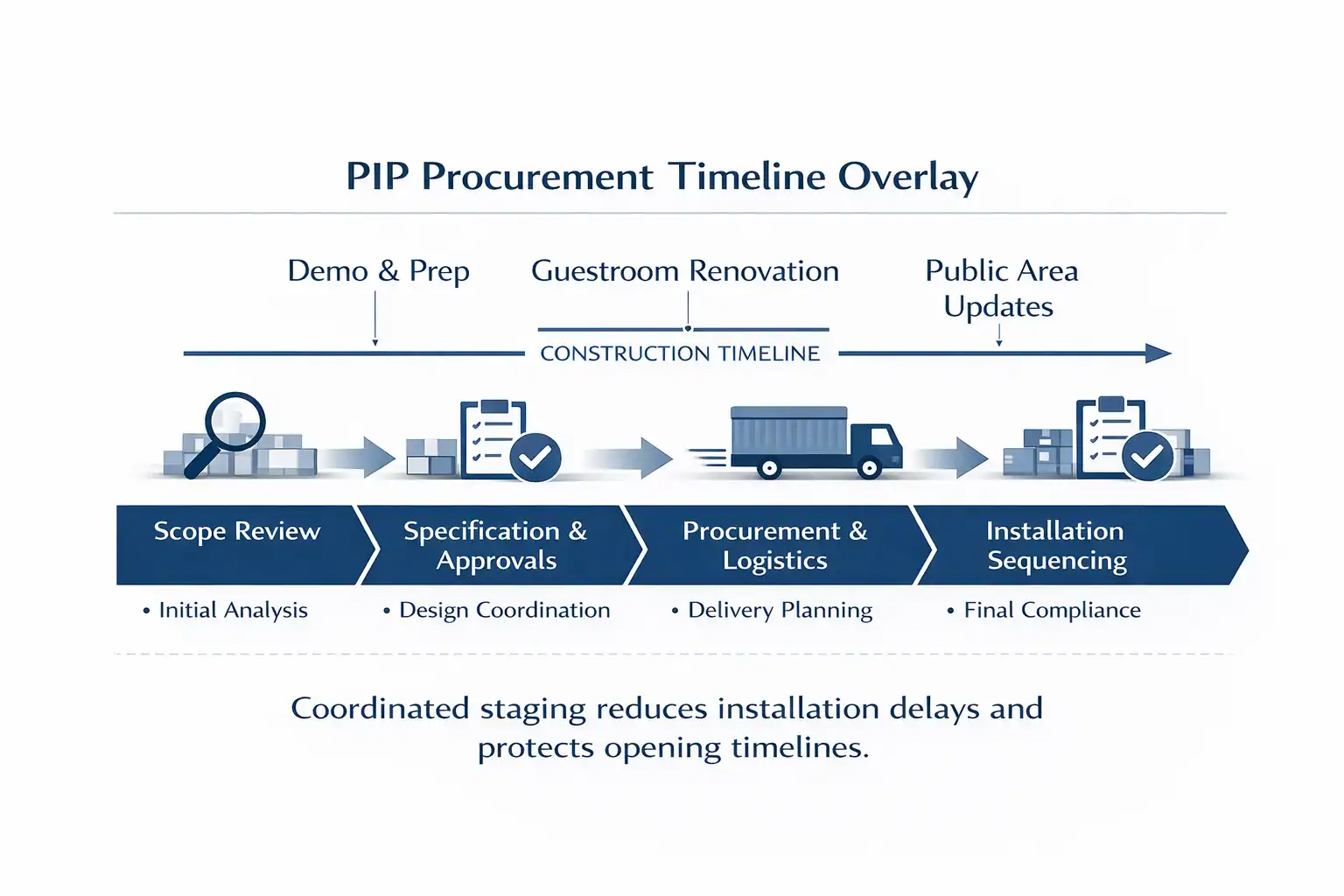
Specification Assistance further supports this alignment by confirming that design intent corresponds with manufacturer capabilities. When specifications are reviewed and clarified early, the likelihood of substitution disputes or late stage revisions is significantly reduced. This proactive coordination helps maintain approval timelines while supporting consistent communication between design teams, vendors, and brand representatives.
In hospitality projects, brand trust and ownership reputation are closely tied to compliance reliability. When procurement is coordinated with brand requirements and renovation milestones, projects move forward with greater clarity and confidence. Structured procurement helps ensure that the renovation process supports both operational readiness and long term brand alignment.
The Real Process Difference: Transaction vs Lifecycle Execution
To understand FF&E procurement versus direct purchasing, it helps to examine how each approach functions throughout a hospitality project.
Direct Purchasing Approach
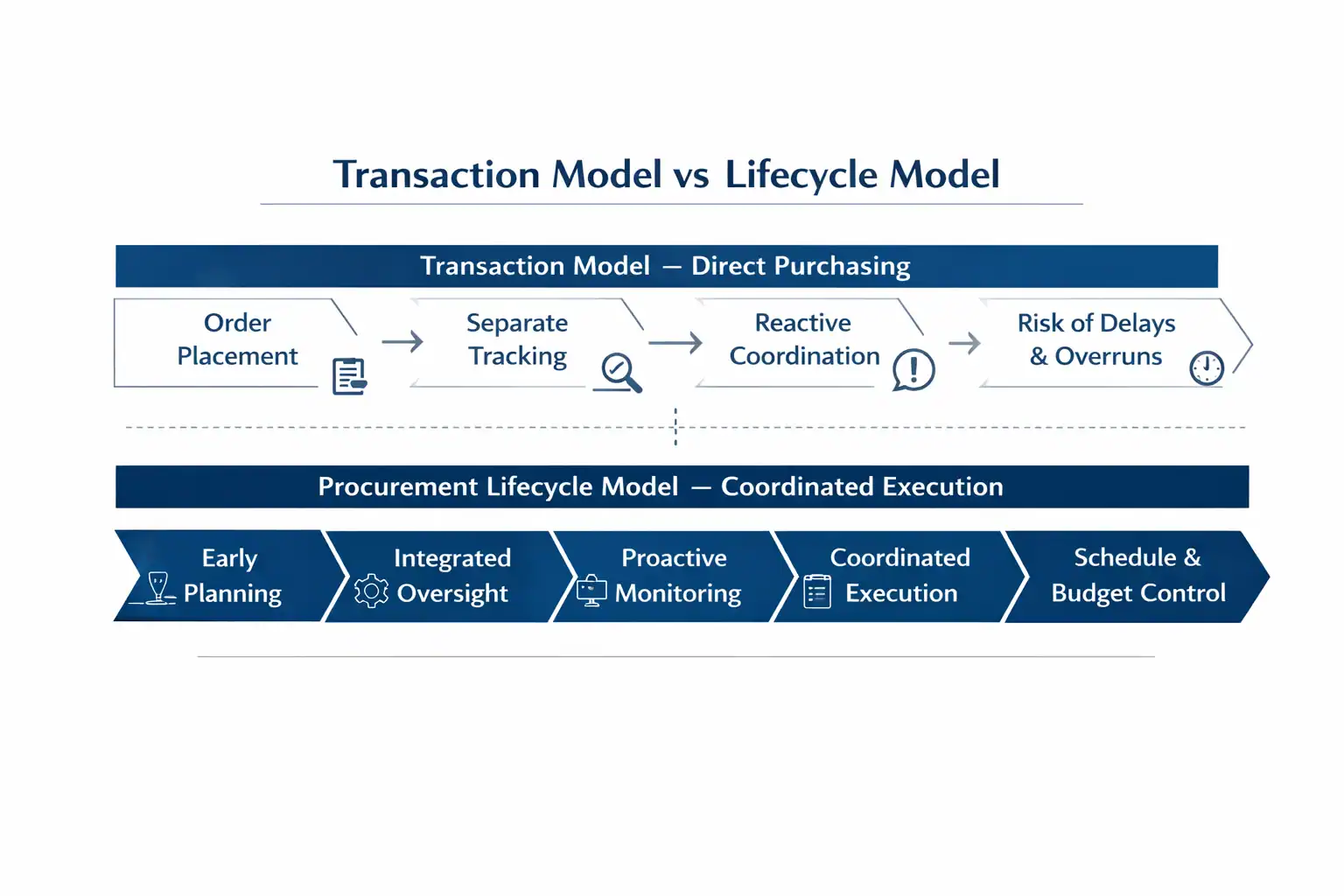
In a direct purchasing model, the owner or project team manages purchasing activities directly with vendors. Once selections are finalized, teams request pricing, issue purchase orders, coordinate deposits, and follow production updates as they become available. Freight is often arranged near the completion of manufacturing, and installation planning begins once goods arrive at the project site or storage facility.
This structure depends heavily on vendor communication and internal coordination. When updates are delayed, incomplete, or misaligned with construction timelines, owners and project teams absorb the impact. Without centralized oversight, procurement activities can gradually drift out of alignment with installation sequencing and broader project milestones.
Structured Hospitality Procurement Process
A structured hospitality procurement process introduces coordination much earlier in the project lifecycle. Beyer Brown’s model establishes disciplined oversight at each stage of procurement, ensuring that purchasing decisions remain aligned with design intent, production schedules, and construction progress.
The procurement lifecycle includes several coordinated checkpoints that guide the project through each stage of execution.
Early Condition Validation
Project scope, quantities, and specifications are reviewed before purchasing commitments are made, ensuring the procurement plan reflects actual project requirements.
Coordinated Specification Review
Design intent is aligned with manufacturer capabilities so that specifications remain consistent across vendors and late stage substitutions are minimized.
Structured Vendor Evaluation
Manufacturers are assessed for reliability, production capacity, and quality standards to confirm their ability to meet project timelines and performance expectations.
Continuous Production Monitoring
Manufacturing progress is tracked throughout production, allowing potential risks to be identified early and addressed before they affect installation schedules.
Integrated Logistics Planning
Freight coordination is aligned with installation sequencing, ensuring goods arrive when they can be received, staged, and installed efficiently.
Installation Coordination and Closeout
Deliveries, inspections, and final installations are coordinated to support operational readiness and confirm that project requirements have been fully met.
This structure is further detailed in The FF&E Procurement Process for Hospitality Projects Explained, which outlines how disciplined procurement coordination supports hospitality project delivery.
The difference is not the volume of tasks involved. It is the presence of a disciplined sequence that keeps procurement aligned with the broader goals of the project. Direct purchasing reacts to vendor updates as they occur, while lifecycle procurement anticipates them through coordinated planning and continuous oversight.
Installation Readiness and Operational Impact
The impact of FF&E procurement versus direct purchasing often becomes most visible during installation. At this stage of the renovation, coordination across vendors, deliveries, and installation teams determines how efficiently the project moves toward operational readiness.
Hospitality installations require careful organization. Goods must be accurately labeled and allocated to the correct rooms, deliveries must arrive in the appropriate sequence, and items must reach the property in damage free condition. Installation teams must also coordinate closely with general contractors to ensure deliveries remain aligned with construction progress, punch list activities, and room turnover schedules.
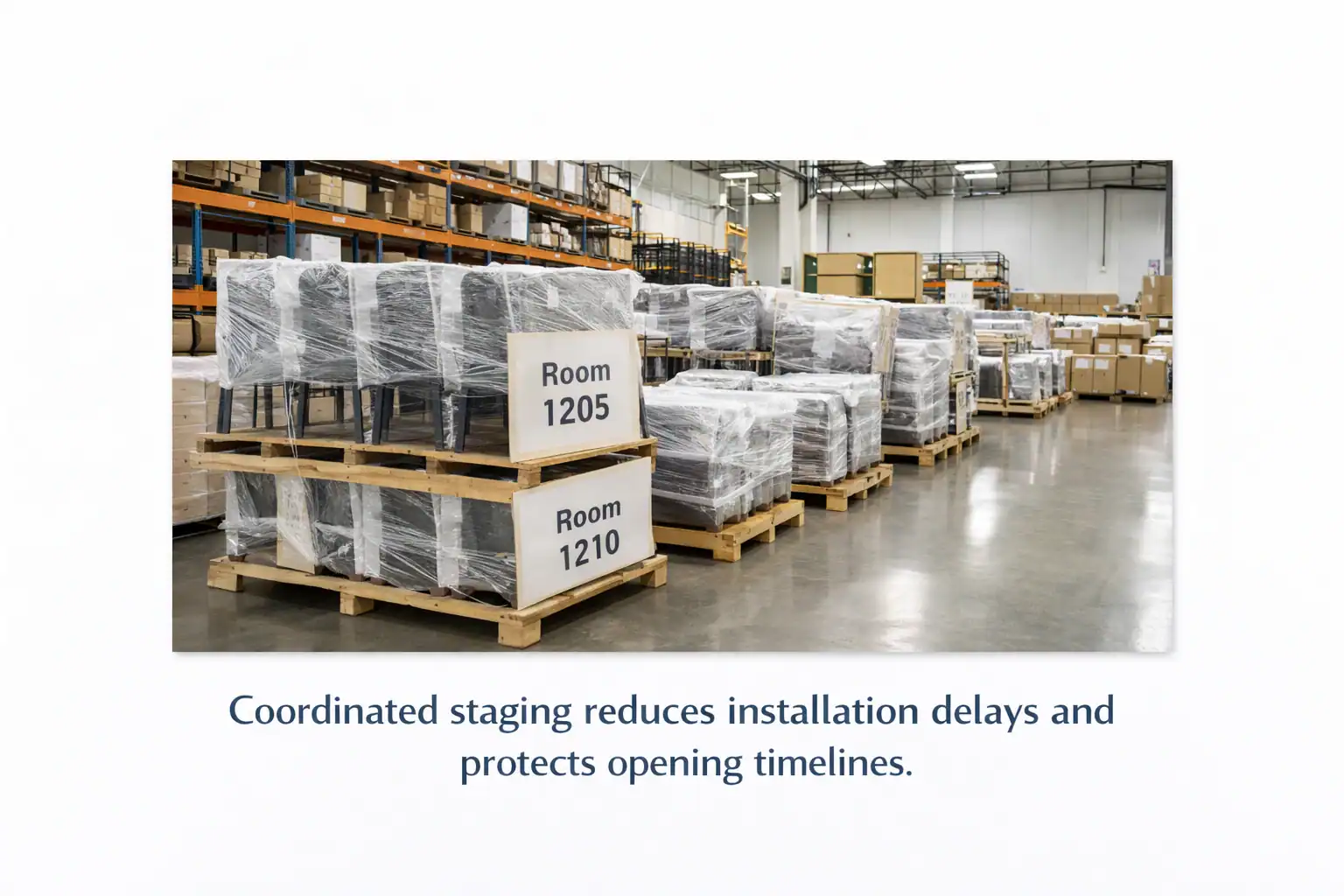
When goods arrive disorganized or misaligned with installation sequencing, inefficiencies can quickly emerge. Installation crews may be forced to wait while items are located or staged. Rooms may remain offline longer than planned, delaying final turnover and slowing the transition to operational readiness. In hospitality environments where opening schedules are closely tied to revenue forecasts, these disruptions can have meaningful financial implications.
Structured procurement helps prevent these challenges through disciplined coordination before goods reach the property. Warehouse staging ensures items are organized and prepared for delivery in the correct installation sequence. Shipments are inspected prior to arrival to confirm condition and accuracy, and replacement coordination can begin immediately if issues are identified. Deliveries are then scheduled in alignment with room turnover, allowing installation teams to work efficiently and maintain construction momentum.
For owners and operators, this stage of the project carries particular visibility. Installation represents the final transition between construction and operations. When procurement has been coordinated throughout the lifecycle, the installation process becomes organized, predictable, and far less disruptive. A smooth installation not only supports opening timelines but also reinforces confidence among brand partners, project teams, and property leadership.
The Strategic Evaluation
The conversation around FF&E procurement versus direct purchasing in hospitality projects often begins with cost. However, experienced owners recognize that procurement decisions influence far more than vendor pricing. They affect capital stability, lender reporting confidence, brand compliance timelines, freight coordination, installation readiness, and the long-term durability of the asset.
Direct purchasing centralizes coordination risk within ownership. Structured FF&E procurement distributes that responsibility across a disciplined lifecycle framework, aligning specification review, production oversight, logistics planning, and installation coordination within a single coordinated process.
When procurement is managed through this structured approach, it becomes a stabilizing force within complex hospitality projects. Budgets remain more predictable, schedules remain better aligned with construction progress, and installations move toward opening with greater organization and clarity.
For owners seeking confidence in how a renovation or development progresses, the distinction between FF&E procurement and direct purchasing is not theoretical. It is a practical decision that influences how smoothly a project moves from planning to opening and how reliably the asset performs over time.
When evaluating FF&E procurement versus direct purchasing for an upcoming hospitality project, understanding the level of coordination required across vendors, logistics, and installation is the first step toward protecting capital and supporting long term operational success.
In hospitality environments where timelines, brand standards, and capital performance intersect, disciplined procurement coordination provides the clarity and stability that complex projects require.