


Verified quantities provide the foundation for accurate purchasing and reporting throughout hospitality procurement. Before a purchase order is issued, a budget is updated, or a progress report is shared, owners and developers need confidence that the quantities behind those activities reflect the approved project scope.
Hospitality projects may require hundreds or thousands of products across guestrooms, public areas, food and beverage venues, meeting spaces, back of house areas, and operational departments. The quantity assigned to each item affects more than the number of products purchased. It influences pricing, deposits, freight, warehousing, installation planning, budget forecasts, and the accuracy of the information presented to ownership.
Quantity information may originate in design specifications, furniture plans, room matrices, architectural drawings, Property Improvement Plan requirements, operational lists, or brand standards. These sources do not always align. Documents may be issued at different stages, guestroom types may change, or a specification may not clearly communicate how many units are required in each location.
Without a disciplined verification process, inconsistencies can remain hidden until purchasing or installation. An overlooked multiplier, outdated room count, or duplicated item may affect several purchase orders and reporting categories. What begins as a small discrepancy can create unplanned costs, additional coordination, or gaps in the finished property.
Beyer Brown connects quantity verification with the broader procurement lifecycle so purchasing decisions are based on documented requirements rather than assumptions. This gives stakeholders confidence that budgets, purchasing commitments, and reports reflect the approved scope.

Why Verified Quantities Matter to Owners and Developers
Owners and developers rely on procurement information to make financial, scheduling, and operational decisions. If the underlying quantities are incomplete or outdated, a budget or report may appear organized while still presenting an inaccurate view of project requirements.
A procurement budget is built through connected inputs. Required quantities are evaluated alongside unit pricing and applicable costs for taxes, freight, warehousing, installation, and other execution requirements. These costs may be calculated differently depending on the item and project, but quantity remains a primary factor in determining the overall financial requirement. If the same discrepancy appears across several room types or purchasing categories, its effect can extend across a significant portion of the budget.
This is why quantity verification is closely connected to preliminary budgeting. Early budgets may appropriately rely on documented assumptions while design information is developing. As plans, specifications, room counts, and selections become more complete, Beyer Brown reviews those assumptions against current project information. Ownership can then distinguish between preliminary allowances, confirmed requirements, and items that still require direction.
Verified quantities also create greater visibility before financial commitments are made. Once approved purchase orders are issued, the project has committed funds based on the quantities and pricing they contain. If too few units are ordered, supplemental purchases, additional approvals, added freight, and revised delivery coordination may be required. If too many units are purchased, ownership may incur unnecessary product costs and face additional decisions regarding storage, returns, or redistribution.
Procurement reporting depends on the same information. Reports may include approved budgets, committed costs, pending decisions, purchase order status, delivery information, and remaining budget amounts. Beyer Brown carries coordinated item information across these records so stakeholders can understand the relationship between approved scope and current purchasing activity.
For ownership and asset management teams, this visibility supports several responsibilities:
-
Evaluating budget changes before additional commitments are made
-
Monitoring purchasing progress across project areas or departments
-
Confirming that required items have been accounted for
-
Preparing for freight, warehousing, installation, and opening expenses
-
Maintaining a clearer record of decisions throughout the project
Verified quantities do not eliminate every source of change. Design revisions, field conditions, brand direction, operational decisions, and product availability can still affect project scope. Their value is found in establishing a documented baseline against which changes can be evaluated. When a quantity changes, ownership can understand what changed, why the revision occurred, and how it affects the budget, purchasing activity, and procurement reporting.
How Beyer Brown Connects Quantity Verification to Procurement
Beyer Brown approaches quantity verification as an integrated part of procurement rather than an isolated counting exercise. The objective is to establish reliable quantity information that can be carried consistently into budgeting, bidding, approvals, purchase orders, logistics planning, and reporting.
The process begins with an understanding of the project scope and the documents that govern each purchasing category. These may include current design drawings, furniture plans, specification packages, room type matrices, operational requirements, brand standards, and owner approved revisions.
Through Beyer Brown’s takeoff and quantity verification services, the team reviews how specified items relate to individual spaces, room types, and overall project quantities. When a quantity matrix is provided by the design or project team, Beyer Brown completes an independent takeoff and compares the results with the information received. This additional review creates a more reliable basis for purchasing before financial commitments are finalized.
That comparison is particularly valuable in hospitality because the same product may apply differently across a property. An item may be required once in a standard king room, twice in a double queen room, and not at all in a suite with a different furniture plan. Public area products must be confirmed against applicable layouts, while operational items may depend on room counts, seat counts, service standards, or departmental requirements.

When documents do not align, Beyer Brown identifies the discrepancy, reviews the applicable records, and coordinates clarification with the appropriate stakeholder. Open questions and assumptions remain visible until direction is received. This prevents an unconfirmed quantity from being treated as an approved purchasing requirement.
The review also connects quantities with specifications. A count may be mathematically correct but still be assigned to an outdated product, finish, room type, or project area. Coordinating quantity information with specification assistance helps ensure purchasing reflects both how many units are required and which approved product should fulfill the requirement.
Once quantities and specifications are aligned, Beyer Brown uses the information to support vendor bidding, pricing comparisons, and budget review. Before purchase orders are released, quantities are reviewed against current approvals, vendor information, and documented revisions. This provides a clear control point between planning and financial commitment.
The same item information then carries into procurement reporting. Rather than treating budgets, purchase orders, and status reports as disconnected records, Beyer Brown maintains continuity among what was planned, what was approved, what was ordered, and what remains outstanding.
Beyer Brown’s broader FF&E procurement services extend that coordination through purchasing, tracking, delivery, installation support, and closeout. Quantity verification becomes part of the information structure used throughout the project lifecycle.
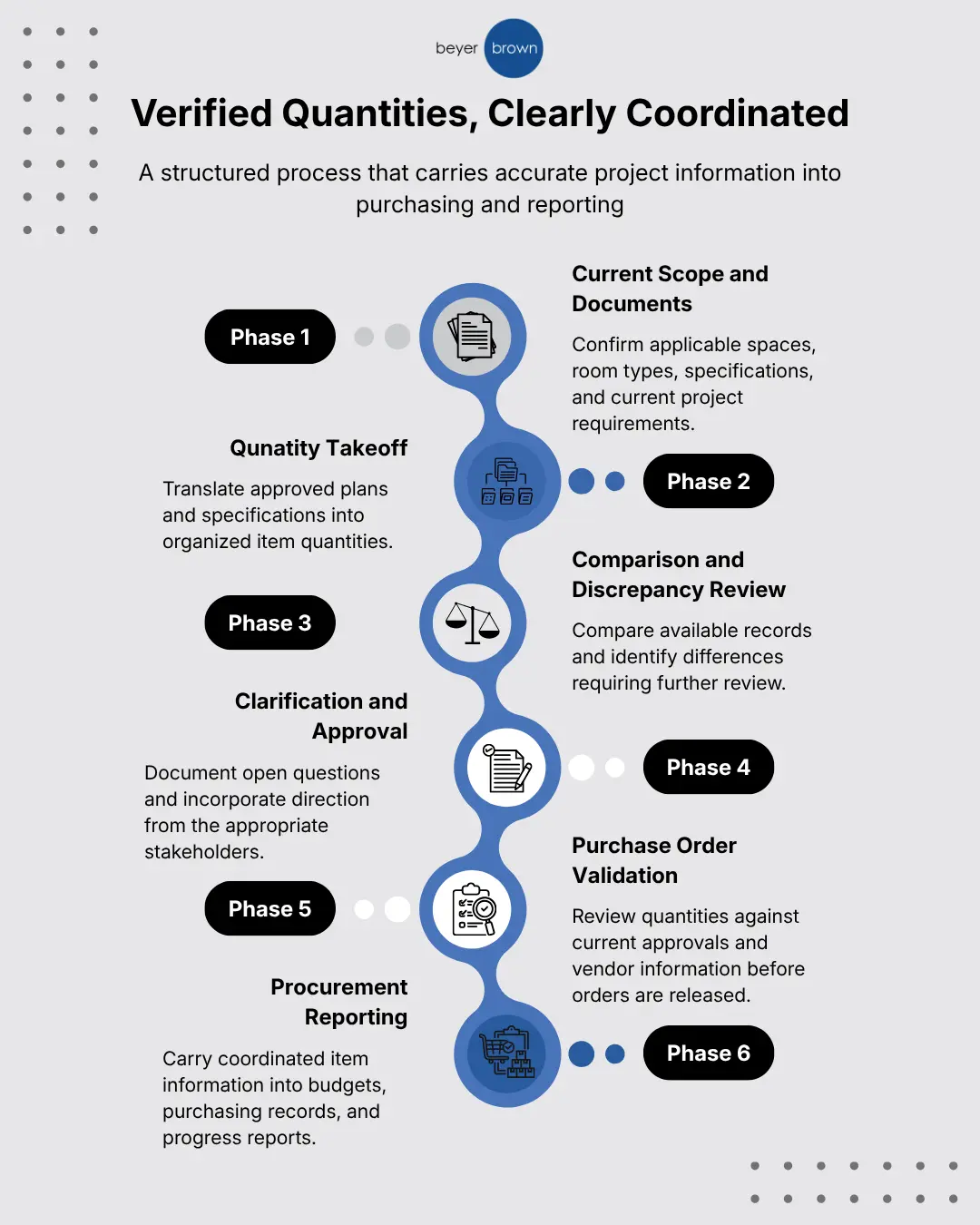
What the Beyer Brown Quantity Verification and Reporting Process Looks Like
Each hospitality project has distinct requirements, but the process depends on current documentation, visible assumptions, defined review points, and coordinated communication.
Step 1: Establish the Current Project Scope
Beyer Brown begins by confirming the areas, room types, departments, and purchasing categories included in the assignment. This clarifies which items belong within the procurement budget and which may be provided by the contractor, operator, owner, brand, or another project participant.
Step 2: Collect and Organize the Governing Documents
The team identifies the current approved documents applicable to quantity verification, which may include:
-
Architectural and interior design plans
-
Furniture plans and enlarged room layouts
-
Design specifications and finish schedules
-
Guestroom and room type matrices
-
Property Improvement Plan requirements
-
Operational equipment and supply lists
-
Brand standards, approved alternates, revision logs, and written clarifications
Confirming which information currently governs the project reduces the risk of carrying an obsolete plan, count, or selection into purchasing.
Step 3: Complete the Takeoff
Beyer Brown translates the project documents into organized item quantities. Products are identified by space, room type, floor, department, or another relevant category. Repeated rooms or areas are then calculated using the confirmed project counts.
The review considers mirrored rooms, accessible room variations, connecting rooms, suites, alternate plans, public area groupings, and other project specific conditions. This hospitality focused review provides context that cannot be gained from a quantity column in isolation.
Step 4: Reconcile Existing Quantity Information
Beyer Brown compares the completed takeoff with available quantity matrices, specification quantities, prior budgets, and other applicable records. When totals align, the comparison provides an additional level of confidence. When they do not, the difference is documented for further review.
A discrepancy may reflect a scope revision, room count change, approved spare product allowance, or an item shown on a plan but omitted from a schedule. Identifying the reason allows the team to resolve the difference before purchasing.
Step 5: Document Questions and Assumptions
Unresolved conditions remain visible to the project team. Beyer Brown documents the applicable item, space, conflicting information, current assumption, and decision required so the responsible stakeholder can respond within the proper project context.
If purchasing must advance while information remains under review, the assumption remains identified until the appropriate stakeholder provides direction.
Step 6: Incorporate Approved Revisions
Quantity verification reflects a specific document set and point in the project. When approved design revisions, room count updates, operational decisions, brand direction, or verified field conditions change the scope, Beyer Brown refreshes the affected quantities and maintains a record of the revision. This keeps budgets and purchasing documents aligned with current approved direction.
Step 7: Validate Quantities Before Purchase Order Release
Before an order becomes a financial commitment, Beyer Brown reviews the item quantity alongside the approved specification, vendor quote, pricing, lead time, and delivery requirements. This helps confirm that the purchase order reflects the latest authorized information and identifies quotes based on an earlier quantity.
Step 8: Carry Verified Information Into Procurement Reporting
As purchasing advances, Beyer Brown carries coordinated quantity information into the applicable budgets, purchase orders, and project reports. Reporting formats vary, but the item information remains connected so stakeholders can see what has been committed, where decisions remain open, and how approved revisions affected the project.
This disciplined sequence reflects Beyer Brown’s broader FF&E procurement process, in which planning, bidding, purchasing, tracking, logistics, installation, and closeout depend on accurate and coordinated information.
The Project Impact of Verified Quantities
The value of verified quantities extends across the procurement lifecycle. By aligning approved scope and purchasing information, Beyer Brown gives stakeholders a dependable basis for financial and operational decisions.
More Accurate Purchasing
Beyer Brown uses verified quantities to prepare purchase orders that more closely reflect approved project requirements. This reduces the likelihood of preventable shortages, duplicate purchasing, and supplemental orders caused by incomplete or inconsistent information.
When additional products are required after an original order, the impact may extend beyond unit cost. New approvals, additional payments, separate freight, and revised installation activities may be required. Early verification reduces exposure to these steps, although later project changes may still require adjustments.
Clearer Budget Visibility and Reporting
Reliable quantities strengthen the connection between approved scope, budget totals, and committed costs. If the scope changes, Beyer Brown can use the established quantity record to identify which requirements changed and carry the approved revision into purchasing and reporting.
Stakeholders gain context regarding the reason for a change, its financial effect, and its purchasing status. Reports can then present a clearer relationship among budgeted requirements, approved purchases, open decisions, and project progress.
Better Vendor and Logistics Coordination
Beyer Brown provides vendors with coordinated quantities for pricing and purchasing. Clearer requirements create a more stable basis for quote comparison, production planning, packaging, and anticipated shipping needs. Confirming quantities before purchase order release also reduces the risk of late changes affecting pricing, production schedules, material availability, or freight arrangements.
As products move through freight, warehousing, delivery, and installation, verified quantities clarify anticipated product volume and provide a reference for reconciling received goods.
Greater Operational Readiness
A hospitality environment depends on having the right products in the right locations. A guestroom missing a required item may not be ready for turnover. An operational department with incomplete equipment may need to adjust training or service preparation. A food and beverage venue may face readiness concerns if necessary products were omitted from the purchasing scope.
By connecting quantity verification with purchasing and delivery coordination, Beyer Brown helps owners and operators prepare for turnover and opening with greater confidence. The objective is not simply to complete orders, but to support spaces that are equipped to function as intended.

A Clearer Record for Future Decisions
Organized quantity and purchasing records can provide useful context for replacements, future renovations, property refreshes, operational planning, and capital expenditure discussions. They allow future teams to understand the basis for prior purchasing decisions without reconstructing the original requirements entirely through invoices or physical counts.
Procurement records should not automatically be treated as a final inventory of installed products. Approved substitutions, replacements, damage, field changes, and later operational purchases may affect what is ultimately present at the property. When reviewed alongside closeout documents and current property information, however, they provide a valuable starting point for future planning.

Verified Quantities Create Confidence Across the Project Lifestyle
Hospitality development involves complexity by nature.
Multiple guestroom types. Brand requirements. Vendor relationships. Revenue projections tied to opening dates.
A disciplined FF&E procurement process reduces volatility within that complexity.
- It replaces assumption with documentation.
- It replaces fragmented communication with structured reporting.
- It replaces reactive correction with proactive oversight.
For seasoned developers and asset managers, this structure is not a luxury. It is a necessity.
Verified quantities are not simply a technical step completed before purchasing. They create a dependable connection among project scope, financial commitments, procurement reporting, logistics planning, and operational readiness.
For owners and developers, that connection provides clearer budget visibility and confidence in purchasing decisions. For designers and brand representatives, it supports the translation of approved specifications into purchasing requirements. For operators, it contributes to the functionality of the property. Vendors, warehouses, and installation partners receive a more reliable basis for execution planning.
At Beyer Brown, quantity information is maintained as part of a coordinated project record. Current documents are reviewed carefully, discrepancies are addressed before they become purchasing issues, assumptions remain visible until resolved, and approved changes are incorporated before affected financial commitments are made.
This approach reflects Beyer Brown’s broader role across the hospitality procurement lifecycle. The objective is not simply to confirm counts. It is to give the project team greater clarity regarding what is required, what has been approved, what has been purchased, and what remains outstanding.
Through disciplined review, clear communication, and coordinated execution, Beyer Brown works as an extension of the project team. Owners, developers, designers, operators, and other stakeholders gain greater confidence that procurement decisions are grounded in reliable information and aligned with the property’s budget, timeline, design, and operational objectives.