
SHARE


Specification gaps in hospitality projects can turn a seemingly minor documentation issue into a broader procurement delay. A missing finish, unclear dimension, unconfirmed quantity, or incomplete installation requirement may prevent a vendor from providing accurate pricing, delay the release of a purchase order, or require the project team to revisit a decision when production should already be underway.
Hospitality projects are particularly sensitive to these gaps because hundreds or thousands of interconnected items must align with the design vision, brand standards, operational needs, budget, construction schedule, and opening plan. Guest room furniture, decorative lighting, window treatments, public area seating, artwork, accessories, and operating equipment all depend on complete, coordinated information.
When a specification lacks the detail required to price, approve, manufacture, deliver, or install an item correctly, procurement cannot advance with confidence. The issue may first appear within a single product category, but its effects can extend to vendor quoting, budget approvals, submittals, production schedules, freight planning, installation sequencing, and opening readiness.
Identifying specification gaps early is more than a documentation exercise. It establishes the clarity needed to reduce uncertainty, protect project alignment, and support a more reliable path through procurement and installation.

Why Specification Gaps Matter to Owners and Developers
Owners and developers rely on project documentation to make informed decisions about cost, scope, timing, and risk. When specifications are incomplete, those decisions may be based on assumptions rather than confirmed information.
A vendor may quote the general product described in a specification but exclude a custom finish, required hardware, specialized packaging, or installation component that was not clearly identified. The initial price may appear complete, yet later clarification can reveal added costs or longer lead times. By that point, the budget may already be approved and the procurement schedule established.
These gaps can expose the project to several interconnected risks.
Pricing Becomes Less Reliable
Vendors need complete product information to provide accurate and comparable pricing. The manufacturer, model, dimensions, materials, finishes, performance criteria, quantities, shipping requirements, and applicable accessories can all affect the final cost.
When information is missing, vendors may interpret the scope differently. One quote may include components that another excludes, making an accurate comparison difficult. The project team may believe it is reviewing equivalent options when the proposals are based on different assumptions.
Clear documentation supports more meaningful quote comparisons and more dependable budget decisions. It also reduces the likelihood that omitted details will later appear as added costs after a selection has been approved.
Approval Cycles Take Longer
Incomplete specifications often create additional questions among ownership, design, procurement, brand, and vendor teams. Each unanswered question can delay the next decision.
If a decorative lighting specification does not include a confirmed finish, for example, the vendor may be unable to complete the required submittal. If the dimensions of a custom headboard conflict with the drawings, the item may need to return to the design team for clarification before shop drawings can proceed. If upholstery is listed without a confirmed fabric application or treatment requirement, the manufacturer may be unable to finalize yardage or production details.
Each clarification requires communication, review, documentation, and approval. Across a large hospitality project, repeated clarification cycles involving multiple items can consume meaningful schedule time.
Production Windows Can Be Lost
Many hospitality products are manufactured to order. Production capacity, material availability, factory schedules, and lead times can change while the project team works to resolve an incomplete specification.
A vendor may provide an estimated lead time during the quoting process, but that estimate does not necessarily reserve production capacity. If a specification remains unresolved and the purchase order cannot be released, the original production window may no longer be available once final approval is received.
This is one reason early FF&E specification assistance matters. Reviewing documentation before purchasing begins helps teams identify gaps, inconsistencies, and impractical selections while there is still time to resolve them thoughtfully.
One Gap Can Affect Several Project Phases
Procurement activities are interconnected. A delayed approval can postpone a purchase order. A delayed order can change the delivery window. A revised delivery window can then affect freight coordination, warehouse planning, installation labor, construction access, and room turnover.
For owners and developers, the concern is not simply that one item may arrive late. The greater concern is that unresolved information can create a chain of dependencies across the project lifecycle.
This becomes especially important during phased renovations and projects involving active hotel operations. If guest rooms, corridors, or public areas must be released according to a defined sequence, a late product can interfere with the ability to complete and reopen each space as planned.
Design Intent and Operational Performance Can be Compromised
Specification gaps also create quality and performance risks. When information is incomplete, the product ultimately purchased may not fully reflect the approved design or operational requirements.
A visually appropriate material may not be suited to hospitality traffic. A table may not provide the clearance required for its intended location. A lighting fixture may depend on installation conditions that were not coordinated. A selected finish may not align with the approved design package or applicable brand standards.
Clear specifications protect more than appearance. They connect design intent with durability, maintenance, safety, guest use, brand expectations, and day to day hotel operations. This alignment gives owners and developers greater confidence that approved selections can be purchased, installed, and used as intended.
How Beyer Brown Addresses Specification Gaps Through Procurement
Beyer Brown approaches specification review as part of the broader hospitality procurement lifecycle. The objective is not to replace the responsibilities of the designer, architect, contractor, operator, or brand representative. It is to connect approved project information with the requirements of pricing, purchasing, production, logistics, and installation.
This procurement perspective matters because a product selection may appear complete from a design standpoint while still lacking information required for execution.
For example, the design package may establish the visual direction for a lounge chair, but procurement may still require confirmation of the manufacturer, dimensions, frame finish, upholstery application, quantity, applicable performance requirements, delivery location, and required accessories. A custom item may also require further coordination related to drawings, samples, testing, packaging, or installation.
Through Beyer Brown’s hospitality FF&E procurement services, specifications, quantities, and scope are reviewed to establish a more reliable purchasing foundation. This structured approach connects design decisions with budget expectations, vendor requirements, lead times, and project schedules.
Reviewing Documentation for Procurement Readiness
Specification review considers whether the available documentation provides the project team and vendors with enough information to price, approve, purchase, manufacture, deliver, and install each item accurately.
Depending on the product and project requirements, the review may consider:
-
Manufacturer and product identification
-
Dimensions and configurations
-
Materials and finishes
-
Upholstery and fabric applications
-
Performance and maintenance requirements
-
Quantities and locations
-
Custom construction details
-
Required accessories or components
-
Brand requirements
-
Submittal and sample expectations
-
Installation considerations
-
Delivery and packaging requirements
The purpose of this review is to make uncertainty visible. A clearly documented question can be assigned, answered, and tracked. An unidentified gap may not surface until a vendor attempts to quote, manufacture, deliver, or install the item, when the available options may be more limited.
Coordinating Clarification With The Appropriate Stakeholders
Specification questions often require input across several disciplines. A designer may need to confirm a finish. An operator may need to validate functionality. A contractor may need to confirm field conditions or installation responsibility. A brand representative may need to evaluate compliance. A vendor may need to assess manufacturing feasibility.
Beyer Brown helps organize and communicate these questions so the appropriate stakeholders can make informed decisions. This creates a shared understanding of the issue, its procurement implications, and the information required to resolve it.
For the client, the primary benefit is greater visibility. Instead of discovering an incomplete requirement after an order has been released, the project team can evaluate the issue in relation to budget, quality, lead time, operational needs, and broader project priorities.
Connecting Specifications With Quantities and Scope
Even a fully described product can create risk when its quantity or intended location is unclear. Specifications must be coordinated with floor plans, room counts, finish schedules, room types, and the overall purchasing scope.
Beyer Brown’s takeoff and quantity verification process helps confirm that purchasing decisions reflect documented project requirements. This review can reveal inconsistencies between specifications and drawings, missing items, duplicated counts, and quantities that require clarification before purchasing begins.
Quantity verification and specification review work together. The specification establishes what is required, while the takeoff helps determine how much is required and where each item will be used. Both must remain aligned to support accurate budgeting, purchasing, and installation planning.
Evaluating Procurement Feasibility
A selection may align with the design vision but still require further evaluation before it can be purchased and executed successfully. Product availability, minimum order requirements, manufacturing capacity, material performance, lead time, freight conditions, installation needs, and budget can all affect procurement feasibility.
When a potential concern is identified, the project team can evaluate available options before the issue becomes urgent. This may involve clarifying the original selection, requesting additional vendor information, considering an approved alternative, or adjusting the procurement sequence.
The objective is not to change the design unnecessarily. It is to provide the information needed to protect design intent while supporting practical execution. Beyer Brown’s article on aligning design intent with procurement through accurate specifications further explains how coordinated specification management helps maintain consistency between approved design decisions and the completed project.

The Real Process for Identifying and Resolving Specification Gaps
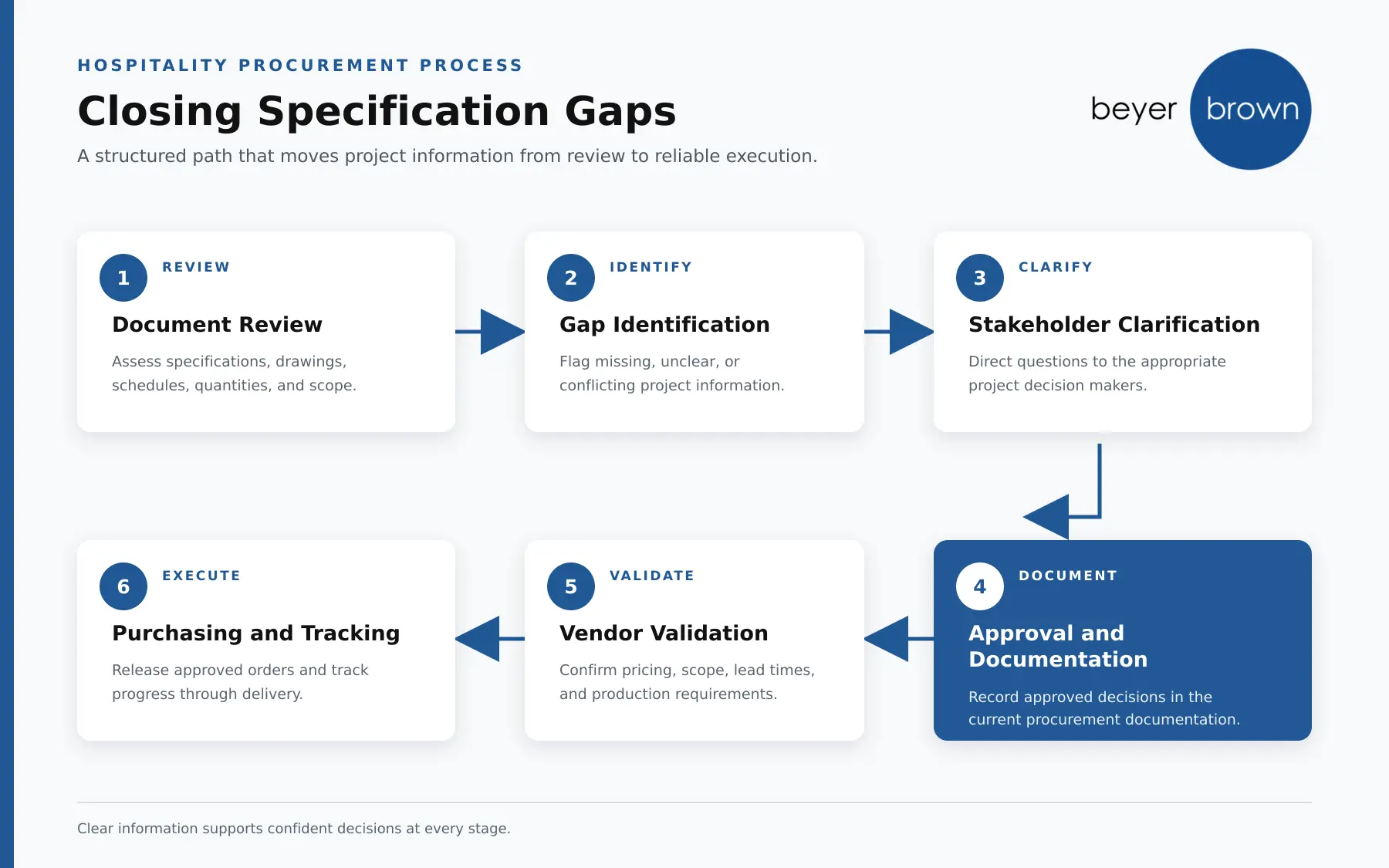
Specification coordination is not completed through a single review. It is a continuing process of evaluation, clarification, approval, and documentation that supports the project as information develops.
Although the requirements vary by project, the process generally includes the following stages.
1. Gather the Current Project Documentation
The process begins by gathering the most current available specifications, drawings, finish schedules, room matrices, brand requirements, quantity information, budget documents, and project schedules.
Document control matters at this stage. If stakeholders or vendors are working from different versions, decisions may be based on outdated or conflicting information. Establishing a current documentation set gives the project team a shared and reliable point of reference.
2. Review Each Item for Completeness
The procurement team evaluates whether each item includes the information required for accurate quoting and purchasing. The specific requirements vary by product category.
A casegood specification may require dimensions, materials, finish details, hardware, construction information, packaging instructions, and power requirements where applicable. Upholstered seating may require frame details, finish selections, fabric assignments, yardage, treatment requirements, and applicable performance criteria. Decorative lighting may require dimensions, light source information, finishes, electrical requirements, mounting details, and installation instructions.
The review also considers whether the project documents agree with one another. A product dimension in the specification should align with the floor plan and intended location. A finish code should correspond with the approved finish schedule. A quantity should align with room counts, room types, and area requirements.
3. Create and Prioritize Clarification Items
Identified specification gaps are organized into clear, actionable questions. Priority is often determined by the project schedule, product lead time, approval requirements, and the consequences of leaving the issue unresolved.
A missing detail on a long lead custom item may require immediate attention if it prevents accurate pricing or production. A question affecting several guest room types may receive priority because of its wider quantity and budget implications. A lower risk accessory may allow more time for clarification.
This prioritization helps the project team focus first on the decisions most likely to affect procurement progress and the broader project schedule.
4. Coordinate Answers With the Responsible Stakeholders
Clarification items are directed to the stakeholders authorized to resolve them. The procurement team can provide relevant vendor information, timing considerations, and potential cost implications so each decision is made with appropriate context.
This stage may involve confirming a design detail, reviewing samples, reconciling conflicting documents, validating a field condition, or obtaining approval from ownership or the brand.
Clear responsibility is essential. Questions may remain unresolved when several parties assume someone else is addressing them. Assigning responsibility and maintaining visibility into each item’s status supports a more disciplined and efficient approval process.
5. Update the Procurement Record
Once a question is resolved, the approved answer should be reflected in the documentation used for quoting, approvals, and purchasing. Email correspondence alone may not provide sufficient continuity if the related specification, quote, or approval record remains unchanged.
Organized documentation helps vendors understand the final requirement and gives project stakeholders a reliable record of the decision. It also reduces the possibility that an outdated detail will reappear during purchasing, production, or installation.
6. Confirm Vendor Pricing and Lead Times
Vendors can provide more dependable pricing and lead time information when the scope is clearly defined. Quotes are reviewed for alignment with the approved specifications, quantities, freight terms, exclusions, estimated lead times, and required services.
If proposals contain different assumptions, those differences should be clarified before the options are evaluated. A lower price does not offer meaningful value if it excludes an essential finish, component, service, or delivery requirement.
The quote comparison and budget analysis stage within Beyer Brown’s FF&E procurement process evaluates quality, timing, pricing, samples, and design intent in relation to the client’s expectations.
7. Complete Submittals, Samples, and Model Room Review
Some selections require shop drawings, finish samples, strike offs, control samples, prototypes, or other submittals before production begins. These materials allow the project team to confirm that the vendor’s interpretation aligns with the approved specification and design intent.
For applicable projects, a model room provides a broader opportunity to evaluate product specifications, dimensions, fit, finish, function, installation requirements, and the relationship among multiple items. Findings can then be addressed before larger quantities enter production.
A model room does not replace the need for accurate specifications. It provides an additional point of validation before full project execution.
8. Monitor Changes Through Purchasing and Production
Specifications may continue to evolve because of approved design changes, product availability, field conditions, brand comments, or operational requirements. When a change occurs, its potential effects should be evaluated across cost, quantity, approvals, production, freight, delivery, and installation.
This ongoing review matters because a change to one detail may affect several related documents, decisions, and project participants. Maintaining a clear record helps keep vendors, procurement teams, ownership representatives, and installation teams aligned as purchasing and production progress.
The Project Impact of Closing Specification Gaps Early
Closing specification gaps does not guarantee that a complex hospitality project will never experience change. It gives the team a stronger foundation for managing evolving conditions without unnecessary disruption.
Complete specifications allow vendors to price a more clearly defined scope. Ownership teams gain better visibility into what is included, what remains unresolved, and which decisions could affect cost. This supports more informed approvals and reduces dependence on allowances or assumptions that may change later.
Clear information also supports more dependable procurement schedules. When vendor questions are addressed earlier, purchase orders can move forward with greater confidence. Long lead products receive attention before timing becomes critical, and production planning is based on confirmed requirements. The result is a more realistic schedule with fewer avoidable pauses.
Accurate and organized documentation also helps stakeholders review consistent information. This reduces conflicting interpretations and limits the need to revisit decisions because a material detail, quantity, or requirement was overlooked. For owners and developers, fewer repeated approval cycles allow internal teams to spend more time guiding the project and less time resolving preventable documentation issues.
The impact extends into construction and installation. FF&E products must be delivered into spaces that are ready to receive them, and installation may depend on access, utilities, blocking, dimensions, finishes, or work completed by other trades. Clear specifications help identify these connections earlier, improve coordination with contractors and installers, and reduce the likelihood of unexpected requirements appearing when products arrive on site.
Specification clarity also protects design and brand intent. When materials, finishes, dimensions, and product details are clearly documented and validated, the completed installation is more likely to reflect the approved design. This consistency becomes especially valuable across repeated guest rooms, multiple public areas, phased renovations, and portfolio programs.
The value extends beyond visual continuity. Accurate specifications support the durability, functionality, maintenance expectations, and guest experience required within the property. They help connect the original design vision with the realities of long term hospitality operations.
These benefits ultimately contribute to opening readiness. Hotel openings require coordination across construction, procurement, operations, staffing, training, and guest preparation. A delay in one product category can place pressure on several of these activities. Reducing delays caused by incomplete specifications gives the project team a clearer path toward room turnover, installation completion, operational setup, and opening. Owners and operators gain greater confidence because progress is guided by verified information, documented decisions, and coordinated execution.

Specification Clarity as a Strategic Procurement Advantage
Specification gaps in hospitality projects are rarely limited to a missing line of information. Left unresolved, they can affect pricing, approvals, purchase order timing, production, logistics, installation, and opening readiness.
A structured specification review process gives owners and developers a clearer understanding of procurement readiness before purchasing commitments are made. It allows project teams to identify unanswered questions, coordinate the appropriate stakeholders, confirm quantities, evaluate procurement feasibility, and maintain a reliable record of approved decisions.
The strategic value lies in continuity. Design intent, brand expectations, operational priorities, budget decisions, vendor requirements, and installation planning remain connected throughout the procurement lifecycle. This alignment gives stakeholders greater visibility into the project and supports more informed decisions as purchasing progresses.
At Beyer Brown, specification assistance is approached within this broader context. The objective is not simply to complete documentation. It is to protect project alignment, reduce uncertainty, and create a more predictable path through procurement, logistics, and installation.
Hospitality projects involve evolving conditions and complex coordination. An experienced procurement partner brings structure to that complexity, communicates potential effects clearly, and helps the team respond with confidence. When specification clarity is treated as a shared project priority, owners, developers, designers, operators, vendors, and contractors are better positioned to protect the original vision while advancing practical execution.
This partnership mindset supports more than an individual purchasing decision. It creates the clarity, coordination, and continuity needed to guide the project toward successful delivery.