
SHARE


In Hotel Renovations, Small Procurement Misalignments Become Operational Disruptions
Hotel renovations rarely operate under ideal conditions. Work often occurs within active buildings, under compressed timelines, and within strict brand and operational requirements. Installation may proceed in phases, access may be limited, and existing infrastructure must be verified rather than assumed. Within this environment, FF&E procurement plays a defining role in whether a renovation progresses with stability or becomes operationally disruptive.
At Beyer Brown, renovation procurement is managed as a structured planning discipline that begins early and continues through installation. Specifications are not finalized until field conditions are validated. Procurement schedules are developed in coordination with construction sequencing, and material availability is evaluated before commitments are made. This level of integrated procurement coordination ensures material decisions support installation readiness.
This approach is shaped by experience in complex hospitality renovation environments where small misalignments can quickly produce measurable disruption. Delayed deliveries, incompatible materials, storage conflicts, and late design revisions are rarely isolated events. They are symptoms of procurement decisions made without full alignment to renovation realities.
By identifying where procurement breakdowns most commonly occur and structuring processes to prevent them, Beyer Brown helps ownership teams protect schedule continuity, financial performance, and operational readiness.
Understanding why renovation procurement requires this level of discipline begins with recognizing how renovation environments differ fundamentally from new construction.
Why Procurement Mistakes Carry Greater Risk In Hotel Renovations Than New Construction
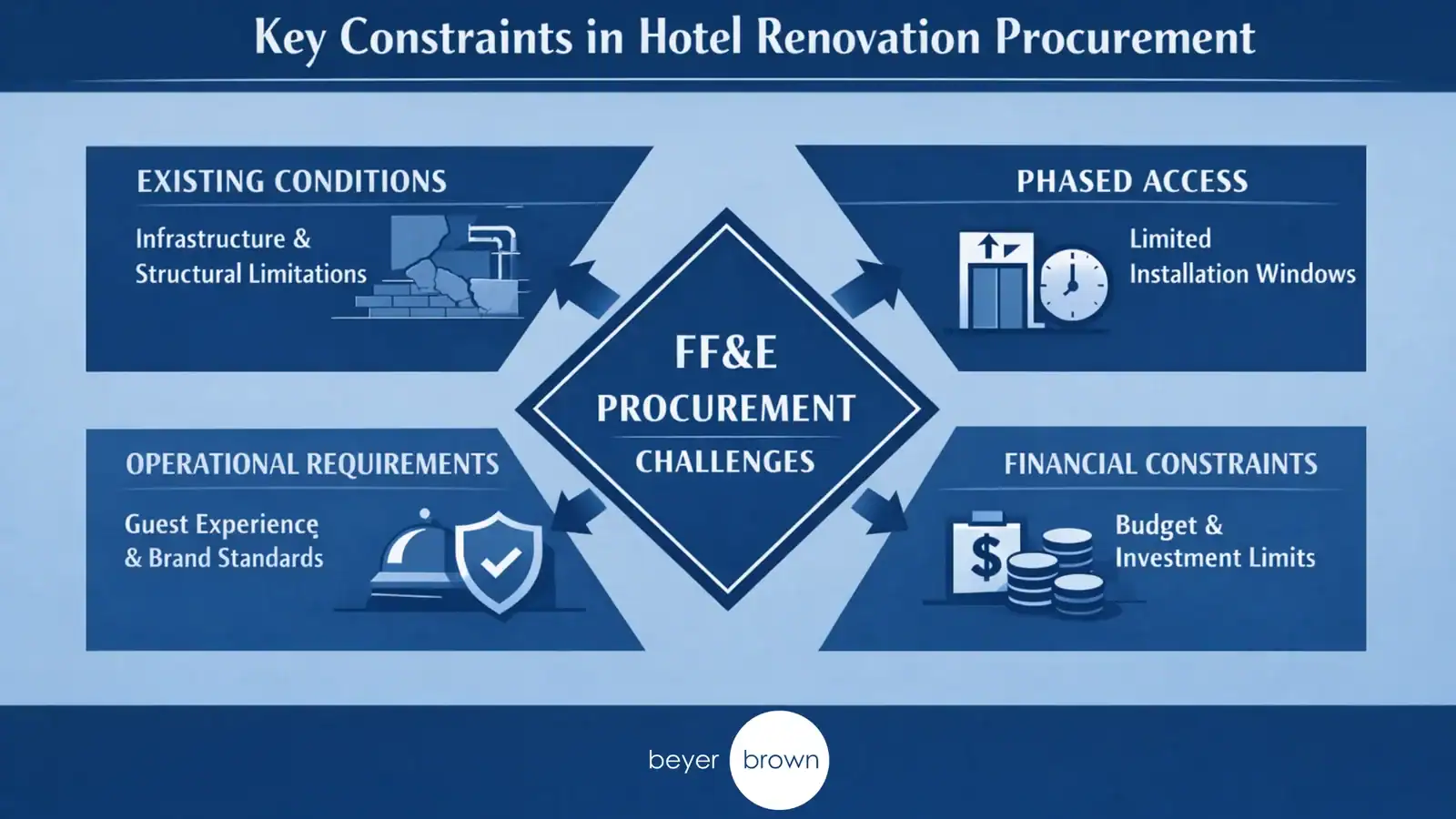
Renovation environments introduce constraints that require a more disciplined procurement approach than new development. Beyer Brown structures renovation procurement specifically around these conditions.
Renovations Operate Within Existing Conditions
Unlike new construction, renovation work must adapt to the physical realities of an existing building. Structural tolerances, mechanical systems, electrical capacity, and spatial constraints influence what can be installed and how installation must occur.
Beyer Brown incorporates field verification and infrastructure evaluation into specification coordination before procurement commitments are made. This ensures that materials ordered for installation reflect actual site conditions rather than assumed design intent.
Installation Windows Are Limited and Phased
Hotels rarely suspend operations entirely during renovation. Work is sequenced across limited access periods, requiring materials to arrive in precise alignment with installation windows.
Beyer Brown integrates procurement scheduling directly with phased construction planning. Delivery timing, staging requirements, and installation sequencing are coordinated as a continuous process, reducing the risk of congestion, rehandling, or delayed installation.
This level of coordination is central to Beyer Brown’s FF&E Procurement Services.
Operational and Brand Requirements Continue During Construction
Renovations must maintain guest experience standards, life safety compliance, and brand approval simultaneously. Procurement decisions must support these conditions without introducing delays or last minute substitutions.
Beyer Brown manages specification coordination and brand compliance review as integrated components of procurement planning. Structured documentation and reporting ensure that selections align with brand requirements before orders are placed.
This alignment is supported through PIP Analysis and Reporting Services.
Financial Flexibility Is Often Limited
Renovations are typically tied to repositioning strategies, financing timelines, or brand improvement mandates. Late cost adjustments are difficult to absorb without affecting investment performance.
Beyer Brown addresses this constraint through early cost validation grounded in supplier engagement, production capacity, and current pricing conditions. Financial frameworks developed through Preliminary Budgeting Services provide ownership with clear cost visibility through structured renovation budgeting before procurement commitments are made.
The Most Common FF&E Procurement Mistakes in Hotel Renovations - and How Beyer Brown Prevents them
Through direct involvement in complex hospitality renovations, Beyer Brown consistently encounters specific procurement failures that disrupt execution. Each reflects a breakdown in coordination between planning, sourcing, and installation.
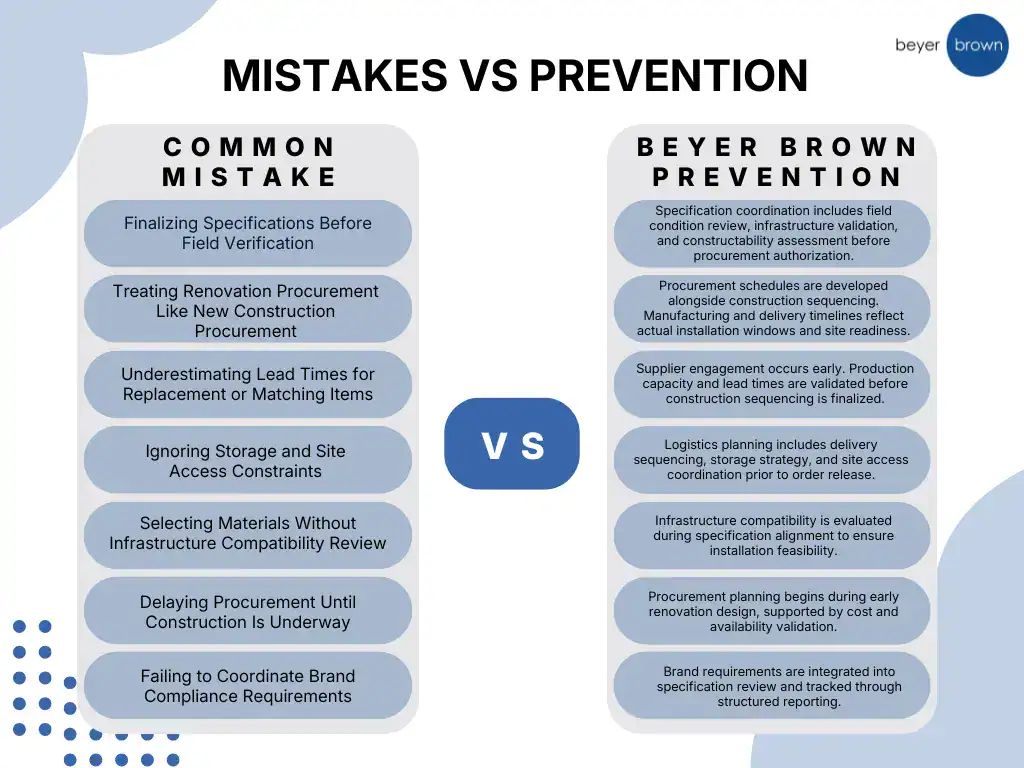
Mistake 1: Finalizing Specifications Before Field Verification
How Beyer Brown prevents this
Specification coordination includes field condition review, infrastructure validation, and constructability assessment before procurement authorization.
Mistake 2: Treating Renovation Procurement Like New Construction Procurement
How Beyer Brown prevents this
Procurement schedules are developed alongside construction sequencing. Manufacturing and delivery timelines reflect actual installation windows and site readiness.
Mistake 3: Underestimating Lead Times for Replacement or Matching Items
How Beyer Brown prevents this
Supplier engagement occurs early. Production capacity and lead times are validated before construction sequencing is finalized.
Mistake 4: Ignoring Storage and Site Access Constraints
How Beyer Brown prevents this
Logistics planning includes delivery sequencing, storage strategy, and site access coordination prior to order release.
Mistake 5: Selecting Materials Without Infrastructure Compatibility Review
How Beyer Brown prevents this
Infrastructure compatibility is evaluated during specification alignment to ensure installation feasibility.
Mistake 6: Delaying Procurement Until Construction Is Underway
How Beyer Brown prevents this
Procurement planning begins during early renovation design, supported by cost and availability validation.
Mistake 7: Failing to Coordinate Brand Compliance Requirements
How Beyer Brown prevents this
Brand requirements are integrated into specification review and tracked through structured reporting.
These failure points are predictable, and with structured lifecycle management, they are largely preventable.
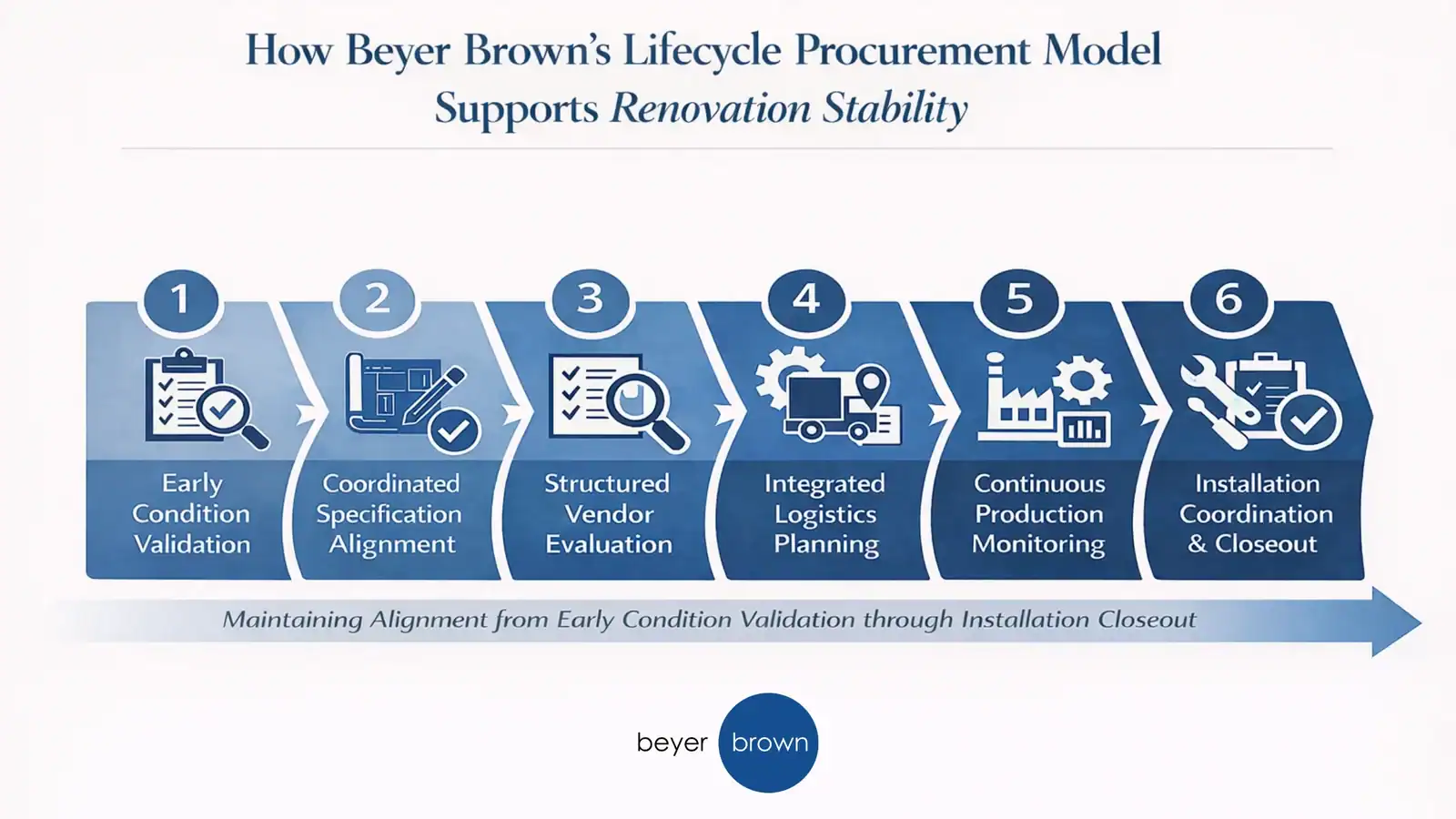
How Beyer Brown's Lifecycle Procurement Model Supports Renovation Stability
Avoiding procurement mistakes requires continuous coordination across all project phases. Beyer Brown manages renovation procurement through an integrated lifecycle model that maintains alignment from early planning through installation.
This includes:
-
Early condition validation
-
Coordinated specification alignment
-
Structured vendor evaluation
-
Integrated logistics planning
-
Continuous production monitoring
-
Installation coordination and closeout
Each phase is intentionally sequenced to maintain alignment between planning, sourcing, and installation.
Project Outcomes When Procurement is Managed Through Beyer Brown's Lifecycle Approach
This structured methodology produces measurable project outcomes:
Installation efficiency improves
Materials arrive in alignment with phased construction access.
Schedule reliability increases
Production and delivery support construction sequencing.
Cost performance stabilizes
Early validation reduces late changes and reactive adjustments.
Operational transition is smoother
Installation sequencing supports reopening readiness.
Asset performance is protected
Selections reflect real infrastructure and use conditions.



Renovation Procurement Requires Discipline, Not Reaction
Procurement disruption in hotel renovations rarely stems from isolated errors. It develops when planning, specification, sourcing, and logistics are not managed as a coordinated system.
Beyer Brown approaches renovation procurement as an integrated discipline designed to maintain alignment across financial planning, construction sequencing, and operational requirements.
For ownership teams, this structured coordination provides more than purchasing support. It provides clarity in planning, control throughout execution, and confidence in project outcomes within complex renovation environments.
This level of coordination allows complex hospitality renovations to progress with stability, precision, and confidence in long term asset performance.
Frequently Asked Questions About FF&E Procurement in Hotel Renovations
What are the most common FF&E procurement mistakes in hotel renovations?
Common mistakes include finalizing specifications before field verification, misaligned delivery scheduling, ignoring storage constraints, and delaying procurement planning.
Why is procurement more complex in hotel renovations than new construction?
Renovations must adapt to existing infrastructure, phased installation, operational continuity, and limited access conditions.
How does structured procurement prevent renovation delays?
Early condition validation, coordinated scheduling, vendor evaluation, and continuous logistics monitoring reduce installation disruption.
When should FF&E procurement planning begin in renovation projects?
Procurement planning should begin during early renovation design, before construction sequencing is finalized.