


Early budget alignment gives hospitality owners and developers a clear financial framework before design decisions, procurement requirements, and project conditions become more complex. Without that framework, scope can expand gradually through revised specifications, added spaces, changing brand requirements, quantity adjustments, or purchasing decisions that appear manageable individually but collectively place pressure on the project budget.
This gradual expansion is commonly known as scope creep. It does not always begin with a major change. More often, it develops through a series of smaller decisions that have not been evaluated against the same approved scope, budget, and project priorities.
A product selection may increase in cost. A public area may require more furnishings than originally anticipated. A renovation may uncover existing conditions that affect quantities or installation. A brand review may introduce additional requirements. An operating department may identify equipment that was not included in the original plan.
Each decision may be justified. However, without a coordinated process for evaluating its financial and operational impact, the project can gradually move beyond its approved budget and scope.
Hospitality preliminary budgeting creates the structure needed to manage these decisions with greater clarity. By connecting scope, design intent, quantities, specifications, schedule requirements, and procurement realities from the beginning, project teams gain a more reliable foundation for protecting the budget as the project evolves.
Change is a normal part of hospitality development and renovation. The objective is not to prevent every change, but to ensure that each one is visible, evaluated, documented, and approved before it creates unnecessary financial or scheduling pressure later.

Why Early Budget Alignment Matters to Owners and Developers
Owners and developers make important financial decisions before every product has been specified or every project condition has been confirmed. During these early stages, the project team may be evaluating financing, brand expectations, renovation requirements, design direction, opening targets, operational priorities, and anticipated return on investment.
A budget developed without a clearly defined scope can create a false sense of certainty. It may provide an overall number, but it does not necessarily explain what that number includes, which assumptions remain unresolved, or how future decisions could affect the total project investment.
Early budget alignment addresses that gap by establishing a shared understanding of what the project is expected to deliver and how available capital should support its priorities.
Scope Creep Often Begins With Unresolved Assumptions
Scope creep is sometimes associated with unnecessary additions, but in hospitality projects, it can also result from incomplete information.
Early budgets may be based on preliminary room counts, conceptual designs, partial specifications, estimated quantities, or broad allowances. These tools are appropriate during early planning, provided the assumptions behind them remain visible and are updated as the project develops.
Problems arise when an assumption is treated as a confirmed project condition.
For example, a preliminary budget may include a general allowance for guestroom seating. As the design advances, the final selection may introduce higher cost materials, custom dimensions, additional pieces, or more complex freight and installation requirements. If the budget is not updated alongside those decisions, the project may appear aligned until vendor pricing is received.
The same issue can occur when certain spaces, room types, taxes, freight costs, warehousing requirements, installation services, attic stock, or operating supplies are not clearly identified within the original scope.
Early alignment allows stakeholders to distinguish among confirmed costs, informed estimates, allowances, exclusions, and decisions that remain open. That visibility gives ownership a more reliable basis for evaluating the project and approving its direction.
Budget Alignment Protects More Than the Initial Cost Plan
For owners and developers, financial control extends beyond whether the project meets an initial budget number. It also affects financing, cash flow, approval timing, construction coordination, operational readiness, and the ability to open the property as planned.
When scope expands later in the project, the team may have fewer practical options. Products may already be approved. Purchase orders may be ready for release. Construction may have advanced based on the original requirements. Vendor lead times may limit alternative selections, and installation dates may already be tied to the opening schedule.
At that point, reducing costs can require redesign, reselection, repeated approvals, or changes to the procurement sequence. These measures can place pressure on both the schedule and the original design vision.
By contrast, early budget alignment allows priorities to be established while the team still has time to evaluate them thoughtfully. Ownership can determine which elements are essential to the guest experience, which support brand compliance, which affect operational performance, and where flexibility may exist if adjustments become necessary.
This creates a more deliberate approach to value. The objective is not simply to reduce spending. It is to direct the available budget toward the decisions that matter most to the property’s performance and long term positioning.
A Shared Financial Reference Strengthens Project Alignment
Hospitality projects bring together owners, developers, asset managers, operators, designers, architects, contractors, brand representatives, consultants, vendors, and procurement professionals. Each stakeholder approaches the project from a different area of responsibility.
Without a shared financial framework, one team may approve a design change without seeing its effect on freight. Another may add an operational requirement without understanding how it affects quantities. A product substitution may reduce the unit cost while increasing installation or maintenance requirements.
Early budget alignment provides a common reference for these conversations. Proposed changes can be evaluated according to their effect on the complete project rather than through only one area of responsibility.
For owners and developers, this supports clearer approvals and makes it easier to understand which decisions are affecting the budget, why they are necessary, and whether they support the project’s broader objectives.

How Beyer Brown Helps Control Scope Through Procurement
Early budget alignment is most effective when it is informed by the realities of hospitality procurement. A budget must eventually translate into quantities, specifications, vendor proposals, approvals, purchase orders, manufacturing schedules, freight planning, warehousing, installation, and closeout.
Beyer Brown approaches preliminary budgeting as part of this larger project lifecycle rather than as an isolated financial exercise. This connects early financial expectations with the decisions and requirements that will ultimately shape purchasing and execution.
Through coordinated FF&E procurement services, the project team gains visibility into how scope decisions may affect product costs, quantities, supplier capabilities, lead times, freight, installation, and overall project delivery.
Establishing a Clear Baseline
The process begins with an understanding of the project’s intended scope and current level of development. Available information may include drawings, room counts, design concepts, specifications, brand requirements, Property Improvement Plan requirements, responsibility matrices, construction milestones, operational needs, and targeted opening dates.
This information helps establish an early financial baseline. Just as importantly, the review identifies what has been confirmed and what still requires clarification.
A useful baseline should make the project boundaries understandable. It should distinguish the spaces, product categories, services, and cost considerations included within the budget from those assigned to another party or not yet defined.
This clarity helps prevent later discoveries from being treated as ordinary budget variance when they are additions to the original scope. It also gives ownership a more reliable point of reference as design and procurement decisions advance.
Connecting Specifications With Financial Expectations
Specifications influence more than product appearance. Materials, finishes, dimensions, performance requirements, customization, minimum order quantities, manufacturing locations, testing requirements, warranties, packaging, and lead times can all affect cost and procurement feasibility.
Beyer Brown’s specification assistance supports coordination between the design information and the requirements needed for accurate bidding and purchasing. When incomplete or conflicting information is identified early, it can be directed to the appropriate stakeholders for clarification before it affects pricing or order release.
This process supports rather than replaces the designer’s creative direction. It provides the procurement information needed to translate that direction into a product that can be accurately quoted, approved, purchased, delivered, and installed as intended.
When specifications and budgets develop together, the team can recognize potential misalignment while practical options remain available. This protects design intent more effectively than waiting until a fully developed selection exceeds the available budget.
Verifying Quantities Before They Become Commitments
An accurate unit price cannot produce an accurate total if the quantity is incorrect.
Room type changes, drawing revisions, duplicated items, omitted spaces, inconsistent matrices, and outdated documentation can all affect the quantities used for budgeting. Even a small discrepancy may become significant when repeated across hundreds of guestrooms or multiple public areas.
Beyer Brown’s takeoff and quantity verification services compare project documentation to help confirm what is required, where it is required, and how much should be purchased. This review can reveal gaps or inconsistencies before they become purchasing errors, budget shortfalls, or unexpected additions.
Verified quantities give owners a more reliable view of the anticipated project cost. They also create a stronger basis for vendor bidding, cash flow planning, order approvals, freight coordination, and installation preparation.
Evaluating Options Within the Complete Project Context
When a selection, requirement, or quantity affects the budget, the decision should not be evaluated by price alone.
Procurement professionals can help the project team consider product quality, design intent, availability, manufacturing capability, lead time, freight, installation, maintenance, operational performance, and brand expectations alongside the proposed cost.
A lower priced alternative may not create meaningful value if it introduces a longer lead time, increases execution requirements, or does not meet the required performance standards. A higher initial cost may be justified when it supports durability, reduces anticipated maintenance, or protects an important element of the guest experience.
The value of early procurement involvement is the ability to make these comparisons while the project still has flexibility. Owners and developers receive clearer information about the available options and can approve changes according to project priorities rather than making rushed decisions under schedule pressure.
This coordinated approach creates the foundation for maintaining budget and scope alignment as the project moves from early planning into bidding, purchasing, delivery, and installation.
How Budget and Scope Alignment is Maintained Throughout Procurement
Early budget alignment is not completed in one meeting. Hospitality projects evolve, and the budget must remain connected to that evolution.
A structured process creates checkpoints where scope, cost, and procurement information can be reviewed together. While every project is different, the following progression illustrates how alignment can be maintained from early planning through purchasing and execution.
1. Define the Project Scope and Responsibilities
The team begins by identifying the areas, room types, FF&E categories, OS&E requirements, and procurement services associated with the project.
Responsibility matrices are particularly important because hospitality scopes frequently cross multiple disciplines. A lighting fixture, window treatment, appliance, accessory, or equipment item may be specified by one party, purchased by another, installed by a third, and approved by ownership or the brand.
Clarifying these responsibilities helps reduce omissions, duplicated allowances, and assumptions about what another team has included.
2. Establish the Preliminary Budget
The preliminary budget creates an informed financial framework based on the information available at that stage. It may draw from project scope, anticipated quantities, specifications, historical project knowledge, supplier conditions, market considerations, brand expectations, and known execution requirements.
At this stage, the budget should clearly communicate its assumptions. Allowances and exclusions should remain visible so they can be evaluated and refined as project documentation advances.
Beyer Brown’s article on what goes into a reliable preliminary budget provides additional context on how early financial visibility supports procurement planning and project coordination.
3. Align the Budget With Design Development
As drawings and specifications become more complete, selections can be reviewed against the established financial framework.
This is an important point for identifying scope creep. New products, upgraded materials, revised room layouts, added spaces, or brand review comments should be evaluated in relation to both their individual cost and their cumulative effect on the project.
A series of manageable changes can create a substantial variance when considered together. Consistent budget updates allow the team to see that progression before the difference becomes difficult to address.
4. Verify Specifications and Quantities
Before bidding and purchasing, current drawings, schedules, specifications, room counts, and quantity information should be coordinated.
The specification establishes what is intended. Quantity verification establishes how much is needed and where each item will be used. Both influence the budget and should reflect the latest approved project information.
Discrepancies should be documented and directed to the appropriate stakeholder for clarification. This helps ensure that vendor pricing is based on a defined scope rather than incomplete, outdated, or conflicting requirements.
5. Obtain and Compare Vendor Proposals
Vendor proposals translate the developing budget into current market information. A competitive and comprehensive bid analysis allows the project team to compare more than the total quoted price.
Product compliance, quantities, materials, exclusions, lead times, freight terms, production requirements, and vendor qualifications may all affect the comparison. If proposals are not evaluated on the same basis, a lower initial price can obscure missing requirements or costs that may emerge later.
Beyer Brown’s documented FF&E procurement process includes vendor bidding, budget analysis, proposal negotiation, purchase order management, product tracking, logistics coordination, installation support, and closeout reporting.
6. Document Decisions and Update the Budget
When a selection changes or scope is added, the resulting budget impact should be documented.
Clear documentation allows ownership to understand the original assumption, the proposed change, the reason for the change, and its effect on the project. This creates a reliable decision trail and reduces confusion when multiple revisions are under review.
Budget updates should also reflect approved scope and product decisions, refreshed quantities, current vendor pricing, and relevant execution costs. The budget becomes progressively more precise as open questions are resolved and additional information is confirmed.
7. Confirm Alignment Before Purchase Orders Are Released
Purchase order release is an important control point because the project is moving from planning into financial commitment.
Before release, the project team should confirm that the product, quantity, price, approval status, delivery requirements, and purchasing responsibility reflect the latest approved direction.
This review helps reduce the risk of ordering against outdated drawings, superseded specifications, or unapproved scope changes. It also gives ownership clearer visibility into committed costs, pending decisions, and remaining financial exposure.
8. Continue Monitoring Through Production, Delivery, and Installation
Budget discipline remains important after purchasing begins. Product changes, production issues, freight conditions, delivery requirements, warehousing needs, site readiness, and installation sequencing may introduce additional decisions.
Ongoing reporting allows potential impacts to be evaluated while the project team still has an opportunity to respond. When project conditions change, current procurement information helps ownership understand the available options and make decisions in relation to the approved budget, schedule, operational requirements, and design intent.

The Project Impact of Early Budget Alignment
The value of early alignment becomes increasingly visible as the project advances. Decisions are supported by a clearer financial framework, and the team is better prepared to manage change without losing sight of the project’s original objectives.
When scope, quantities, specifications, and procurement requirements are coordinated early, the budget provides a more dependable basis for approvals and capital planning. This does not mean the budget will never change. Market conditions, design development, existing building conditions, or revised project requirements may still influence cost. The difference is that these changes can be recognized and evaluated within an established financial framework. Ownership gains clearer visibility into what changed, why it changed, and how the decision affects the project as a whole.
Early alignment can also reduce the need for redesign and reselection later. Discovering budget misalignment after design completion may require products to be reselected, specifications to be revised, samples to be resubmitted, and brand or ownership approvals to be repeated. Coordinating procurement and budget considerations during design development gives the project team an opportunity to evaluate materials, customization, product availability, lead times, and cost before a selection becomes fully integrated into the approved design. This supports a more efficient approval process while helping protect the original design vision.
A clearly defined scope also strengthens procurement readiness. Vendors receive more complete requirements, proposal comparisons become more reliable, and purchase orders can be developed from better coordinated information. Verified quantities and specifications further reduce the likelihood that missing requirements will surface after orders have been released. The result is not simply a more efficient purchasing process. It is a more reliable transition from planning into execution.
This preparation also helps protect the project schedule. Late scope changes can affect more than cost. A revised product may require new samples, additional approvals, updated shop drawings, production time, freight arrangements, or installation coordination. When budget questions are addressed earlier, the team has more time to evaluate available options without placing unnecessary pressure on critical project milestones. Long lead items can receive attention before their timing becomes urgent, and purchasing can be coordinated more effectively with construction and installation requirements. This supports a more realistic and coordinated path toward project completion and opening.
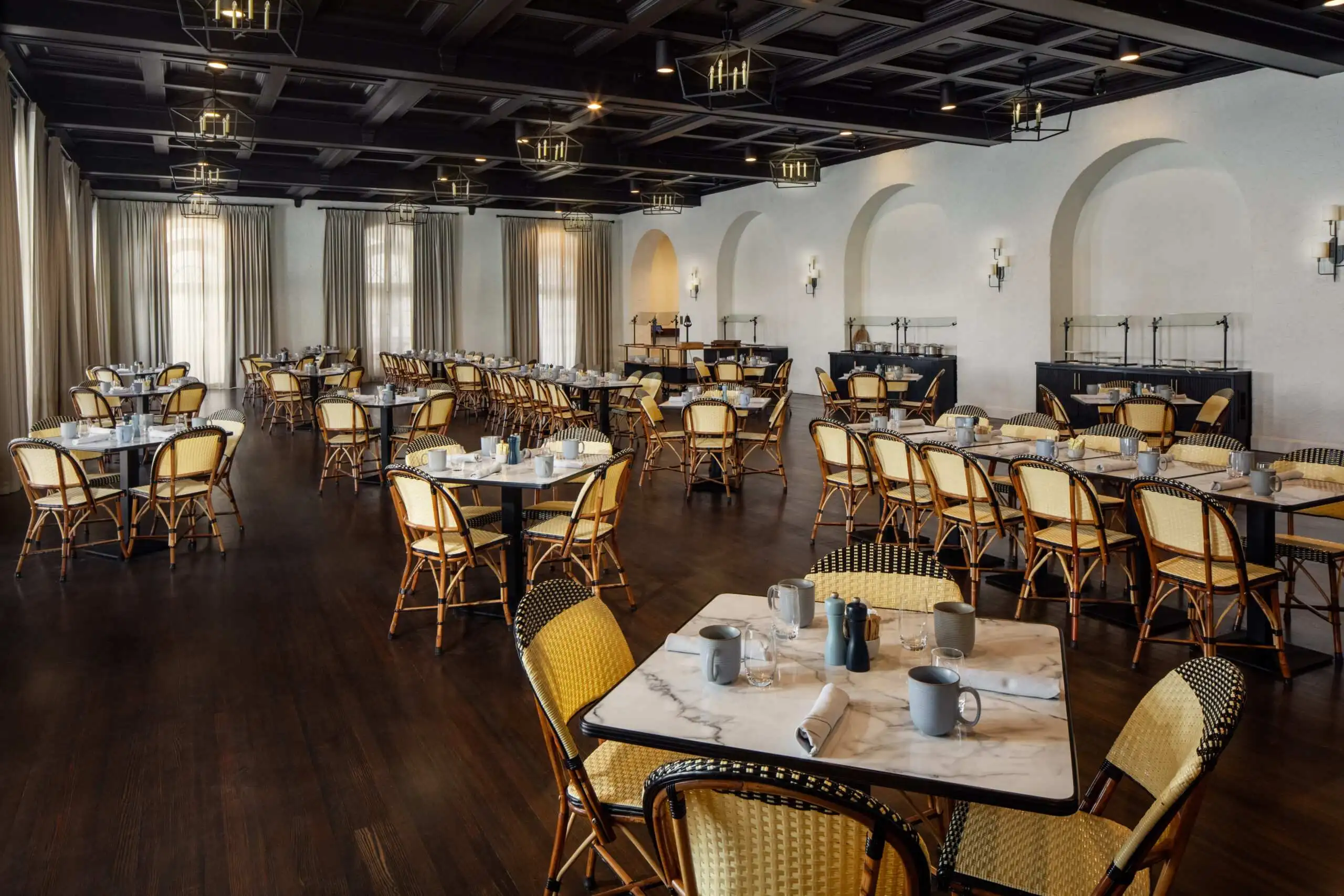
Clear financial information also improves communication among ownership, design, construction, operations, brand, and procurement teams. Stakeholders can evaluate decisions using the same documented scope and better understand how individual choices connect to the project as a whole.
That shared visibility creates confidence. Owners can remain appropriately involved in key decisions without carrying the burden of daily vendor and purchasing coordination. Designers gain clearer parameters for developing and protecting the design vision. Contractors and installers receive better coordinated information. Operators gain greater assurance that opening requirements are being considered throughout the process.
Early budget alignment therefore supports more than cost control. It creates stronger conditions for a coordinated hospitality project and gives each stakeholder a clearer understanding of how decisions support the project’s financial, operational, and design objectives.
Early Budget Alignment Creates a Stronger Path to Project Delivery
Early budget alignment helps prevent uncontrolled scope creep by giving every project decision a clear financial and operational context. It establishes what the project includes, makes unresolved assumptions visible, connects design development with procurement realities, and creates a process for evaluating change before it becomes a disruption later in the project.
For owners and developers, this structure supports more reliable capital planning, clearer approvals, stronger budget visibility, and greater confidence as the project moves toward purchasing and installation.
For the broader project team, alignment creates a shared reference point. Designers, operators, brand representatives, contractors, vendors, and procurement professionals can better understand how their decisions affect the project’s scope, schedule, and financial objectives.
The strongest budgets are not static documents. They develop alongside the project, becoming more accurate as specifications are completed, quantities are verified, vendor proposals are received, and procurement requirements are confirmed. Consistent review allows change to be managed deliberately rather than discovered after the project’s flexibility has narrowed.
At Beyer Brown, early budgeting is connected to a broader hospitality procurement strategy focused on clarity, accuracy, coordination, and lifecycle execution. Preliminary budgeting establishes the financial framework, while procurement carries that framework through specification review, quantity verification, competitive bidding, purchasing, logistics, installation, and closeout.
The value of this partnership lies in continuity. Financial expectations established during early planning remain connected to the decisions made throughout procurement and execution. Owners and developers gain a consistent source of information as the project evolves, helping them evaluate changes without losing sight of the original budget, schedule, operational priorities, or design vision.
This approach does not assume that complex hospitality projects will remain unchanged. It gives owners and developers the information needed to respond to change thoughtfully while protecting the project’s financial, operational, and design objectives.
When early financial planning and procurement remain aligned, the project team gains more than an estimate. It gains a structured path for making informed decisions, managing complexity, and moving forward with confidence from initial planning through final delivery.