


Accurate PIP reporting gives hotel owners, developers, and asset managers the clarity needed to make informed decisions before renovation planning moves forward. A Property Improvement Plan outlines the improvements required to satisfy brand standards, but the document itself is only the starting point.Its value depends on how accurately those requirements are interpreted, validated, and integrated into a coordinated procurement strategy.
Hospitality renovations involve far more than replacing furniture or refreshing finishes. Every recommendation within a Property Improvement Plan can influence project budgets, procurement schedules, operational planning, and ultimately the guest experience. When requirements are misunderstood, incomplete, or interpreted differently across project teams, uncertainty grows. Budget assumptions become less reliable, procurement decisions become more difficult, and project risks become harder to anticipate.
For owners and developers, confidence begins with visibility. Understanding the full scope of a Property Improvement Plan before purchasing decisions are made creates a stronger foundation for budgeting, scheduling, and stakeholder alignment. It also allows project teams to identify unanswered questions, clarify priorities, and resolve potential challenges while there is still flexibility to make informed decisions.
This is where experienced hospitality procurement provides strategic value. Rather than treating a PIP as a checklist of required improvements, Beyer Brown approaches it as the foundation for a disciplined procurement strategy. Through structured document review, specification verification, quantity validation, and coordinated planning, the information contained within a Property Improvement Plan becomes a reliable framework for procurement decisions and successful project execution.

Why Accurate PIP Reporting Matters to Owners and Developers
For hotel owners and developers, every renovation decision carries financial, operational, and long term strategic implications. Before budgets are approved, schedules are established, or purchasing begins, leadership teams need confidence that they fully understand the scope of the investment ahead. Accurate PIP reporting provides that confidence by translating brand requirements into clear, actionable information that supports informed decision making.
A Property Improvement Plan identifies the improvements required to align a hotel with current brand standards, but it does not automatically provide a complete picture of the work required to execute those improvements. Requirements often span hundreds of FF&E, OS&E, architectural, and operational considerations. Without careful review and validation, critical details can remain open to interpretation, creating uncertainty during budgeting, scheduling, and procurement planning.
This uncertainty often appears long before purchasing begins. Ownership teams may question whether preliminary budgets accurately reflect the project scope, whether procurement lead times have been properly considered, or whether the available documentation provides enough detail to support financial approvals. Even relatively small gaps in information can influence capital planning, purchasing strategies, and overall project coordination as the renovation moves forward.

Accurate PIP reporting creates greater visibility before significant financial commitments are made. When requirements are clearly understood, ownership teams can evaluate priorities with greater confidence, establish more realistic budgets, identify potential risks earlier, and align stakeholders around a shared understanding of project objectives. This clarity allows decisions to be based on verified information rather than assumptions that may change as the project progresses.
The value of that visibility extends beyond individual purchasing decisions. Accurate reporting creates a shared understanding among owners, designers, operators, brand representatives, lenders, contractors, and procurement partners, allowing decisions to be made using consistent project information. As a result, approvals become more efficient, expectations remain aligned, and procurement can move forward with greater confidence.
Ultimately, accurate PIP reporting is not simply about documenting renovation requirements. It establishes the foundation for disciplined planning throughout the hospitality project lifecycle. The more clearly ownership understands the project scope before procurement begins, the better positioned the entire team is to manage budgets, schedules, coordination, and execution while protecting both the guest experience and the owner's long term investment.
How Beyer Brown Brings Clarity to PIP Reporting Through Procurement
Accurate PIP reporting delivers the greatest value when it is translated into a clear, coordinated procurement strategy. While a Property Improvement Plan establishes the improvements required to satisfy brand standards, successful execution depends on understanding how each recommendation influences purchasing, scheduling, budgeting, and overall project coordination. This is where experienced hospitality procurement creates the clarity needed for confident project planning.
At Beyer Brown, the process begins with a disciplined review of the Property Improvement Plan alongside architectural drawings, specifications, finish schedules, brand requirements, and supporting documentation. Rather than evaluating each document independently, the information is reviewed as a coordinated body of project information. This approach identifies inconsistencies, clarifies unresolved requirements, and establishes a more complete understanding of the project scope before procurement decisions are made.
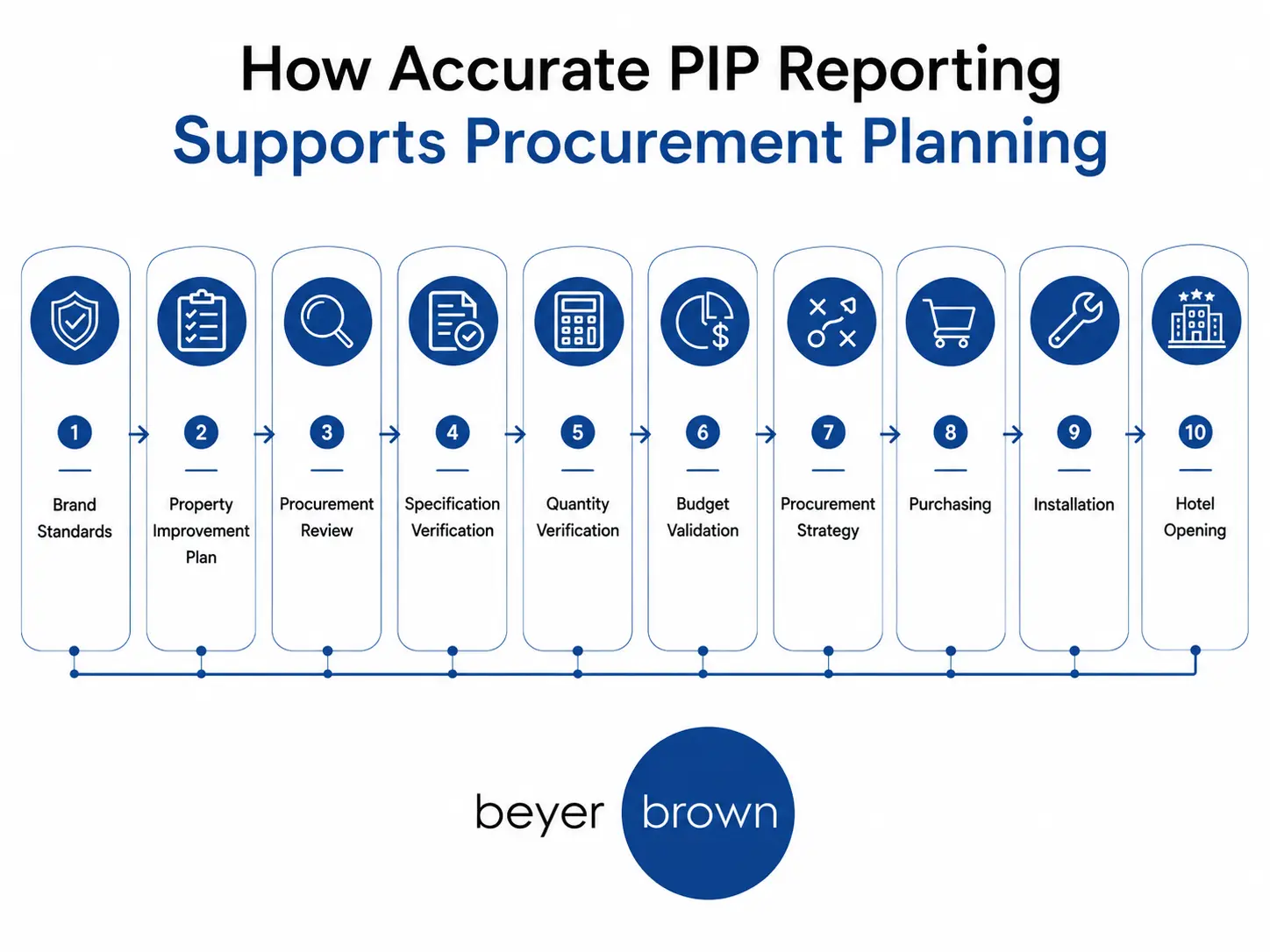
As the review progresses, specifications are verified to confirm that products, materials, finishes, and performance requirements are fully documented. Quantities are validated against drawings and room counts to improve purchasing accuracy, while procurement planning considers manufacturing lead times, project sequencing, installation requirements, and budget objectives. Together, these activities replace assumptions with verified project information, creating a stronger foundation for confident procurement decisions.
This structured approach also strengthens communication across the project team. Owners, designers, operators, brand representatives, contractors, manufacturers, vendors, and procurement professionals all rely on accurate information throughout the project lifecycle. Establishing a shared understanding of project requirements before purchasing begins reduces unnecessary clarification during later phases, streamlines decision making, and keeps project teams aligned around the same objectives.
The objective extends well beyond purchasing products. It is to develop a procurement strategy that aligns design intent, operational requirements, financial objectives, and construction schedules into a coordinated execution plan. When procurement planning begins with accurate, validated information, ownership teams gain greater confidence that every purchasing decision supports both immediate project priorities and the property's long term success.
This disciplined approach allows projects to move forward with greater clarity rather than reacting to uncertainty as construction progresses. By establishing a reliable procurement strategy early in the process, Beyer Brown creates the coordination and confidence needed to carry accurate PIP reporting into successful project execution.
What Accurate PIP Reporting Looks Like in Practice
Every hospitality project presents a unique combination of brand standards, existing property conditions, operational priorities, and ownership objectives. Although no two Property Improvement Plans are identical, experienced procurement follows a disciplined methodology that transforms project requirements into a coordinated strategy for execution.
The procurement process begins with a comprehensive review of the Property Improvement Plan alongside architectural drawings, interior design documentation, finish schedules, specifications, room counts, and brand standards. Reviewing these documents together creates a complete understanding of the project scope and establishes a coordinated foundation for procurement planning. Instead of relying on individual documents in isolation, every requirement is evaluated within the context of the overall project.
As documentation is analyzed, procurement teams verify specifications, confirm quantities, identify missing information, and reconcile details across multiple project documents. This process confirms that product selections, finishes, dimensions, and scope requirements remain consistent before purchasing activities begin. Questions are addressed early, allowing project teams to resolve uncertainties while there is still flexibility to make informed decisions.
Once the project scope has been validated, procurement planning shifts toward execution. Manufacturing lead times are evaluated, purchasing priorities are established, and procurement schedules are coordinated with construction sequencing and installation milestones. This proactive approach allows purchasing activities to move forward with verified information rather than reacting to unforeseen issues during later stages of the project.

Clear communication is just as essential as accurate documentation. Procurement decisions influence owners, designers, operators, contractors, manufacturers, vendors, and installation teams throughout the project lifecycle. Establishing a shared understanding of project requirements early in the process streamlines approvals, reduces unnecessary clarification, and allows every stakeholder to make decisions using the same verified information.
Ultimately, this disciplined approach delivers far more than organized project documentation. It provides owners with confidence that procurement decisions are grounded in verified information, coordinated planning, and a clear understanding of project priorities. By reducing uncertainty before purchasing begins, projects maintain momentum more effectively while protecting budgets, schedules, and the original design vision.
The Project Impact of Accurate PIP Reporting
The value of accurate PIP reporting extends well beyond the planning phase. When project requirements have been reviewed, validated, and aligned before procurement begins, every stage of the project benefits from greater clarity and coordination. Decisions become more predictable, procurement activities move forward with greater confidence, and project teams are better prepared to manage the complexity of hospitality renovations.
Greater confidence in project budgeting is one of the earliest outcomes of accurate reporting. Although every hospitality project evolves as decisions are refined, validated project information provides ownership with a clearer understanding of project scope before significant purchasing commitments are made. Procurement strategies can then be developed around verified information rather than assumptions, allowing financial decisions to reflect a more reliable picture of the overall investment.
Schedule reliability also improves when procurement planning begins with accurate information. Procurement timelines depend on confirmed specifications, validated quantities, manufacturing lead times, and coordinated installation sequencing. Understanding these requirements early allows purchasing activities to align more effectively with construction milestones, reducing avoidable interruptions and creating a more predictable path toward project completion.
Accurate reporting also strengthens coordination across the entire project team. Owners, designers, operators, contractors, manufacturers, vendors, and procurement professionals all depend on the same project information to make informed decisions. When documentation has been reviewed and validated before purchasing begins, communication becomes more consistent, approvals move more efficiently, and project teams spend less time resolving preventable questions during execution.

Perhaps the greatest long term benefit is protecting the original design vision. Hospitality renovations are shaped by thousands of interconnected decisions, each building upon the accuracy of the information established before procurement begins. A disciplined procurement strategy maintains continuity between brand standards, design intent, budgeting, purchasing, and installation, creating a finished environment that reflects the project's original objectives.
Successful hospitality projects are rarely defined by a single procurement decision. They are the result of hundreds of coordinated decisions that build upon one another throughout the project lifecycle. Accurate PIP reporting creates the clarity that keeps those decisions aligned, giving ownership greater confidence as the project progresses toward opening with consistency, coordination, and a shared understanding of success.

Building Better Hospitality Projects Begins with Better Information
Accurate PIP reporting is far more than a documentation exercise. It creates the clarity owners, developers, designers, operators, and procurement teams need to make informed decisions with confidence before purchasing begins. Every verified requirement, confirmed quantity, and coordinated specification strengthens the foundation for budgeting, scheduling, procurement planning, and the successful delivery of the finished property.
Hospitality projects are built through thousands of interconnected decisions, each relying on the accuracy of the information established before procurement begins. When Property Improvement Plans are carefully interpreted, validated, and integrated into a disciplined procurement strategy, uncertainty is reduced, collaboration becomes more effective, and project teams move forward with a shared understanding of project objectives. This level of coordination creates a more predictable path to installation while protecting both the owner's investment and the original design vision.
At Beyer Brown, accurate PIP reporting is approached as one component of a comprehensive hospitality procurement strategy. Thoughtful analysis, specification verification, quantity validation, procurement planning, and coordinated execution work together to create the clarity required for confident decision making throughout the project lifecycle. The objective extends beyond purchasing products. It is to develop a procurement strategy that aligns brand standards, operational priorities, project budgets, and long term ownership goals while creating confidence at every stage of the project.
Every hospitality project presents unique opportunities and challenges, but the value of accurate information remains constant. A procurement strategy built on accurate information allows project teams to navigate complexity with greater confidence, maintain alignment throughout execution, and deliver hospitality environments that reflect both the project's vision and the owner's long term objectives.
Every successful hospitality project begins with informed decisions. Accurate PIP reporting creates the clarity that allows those decisions to become coordinated action, giving owners and project teams the confidence to move forward with alignment, discipline, and a shared vision for success.