



A hotel PIP, or Property Improvement Plan, is one of the most important documents an owner may face during a brand conversion, acquisition, renovation, or repositioning effort. It outlines the improvements required to align a property with brand standards and often shapes the scope, budget, timeline, and approval path for the project.
The challenge is that many owners receive a PIP before there is full clarity around cost, sequencing, procurement strategy, or overall project impact. Requirements may appear straightforward on paper, but the complexity becomes clearer once teams begin interpreting scope, reviewing quantities, aligning specifications, and building a realistic execution plan.
This is where projects often begin to lose momentum.
Without structure early, a hotel PIP can lead to budget uncertainty, delayed approvals, and fragmented decision making. What should function as a roadmap can begin to feel unclear and reactive.
For owners and developers, the priority is not simply completing a list of requirements. It is understanding what the PIP means for the property, how it affects investment decisions, and how to move through execution with clarity and control.
Why Hotel PIPs Matter to Owners and Developers
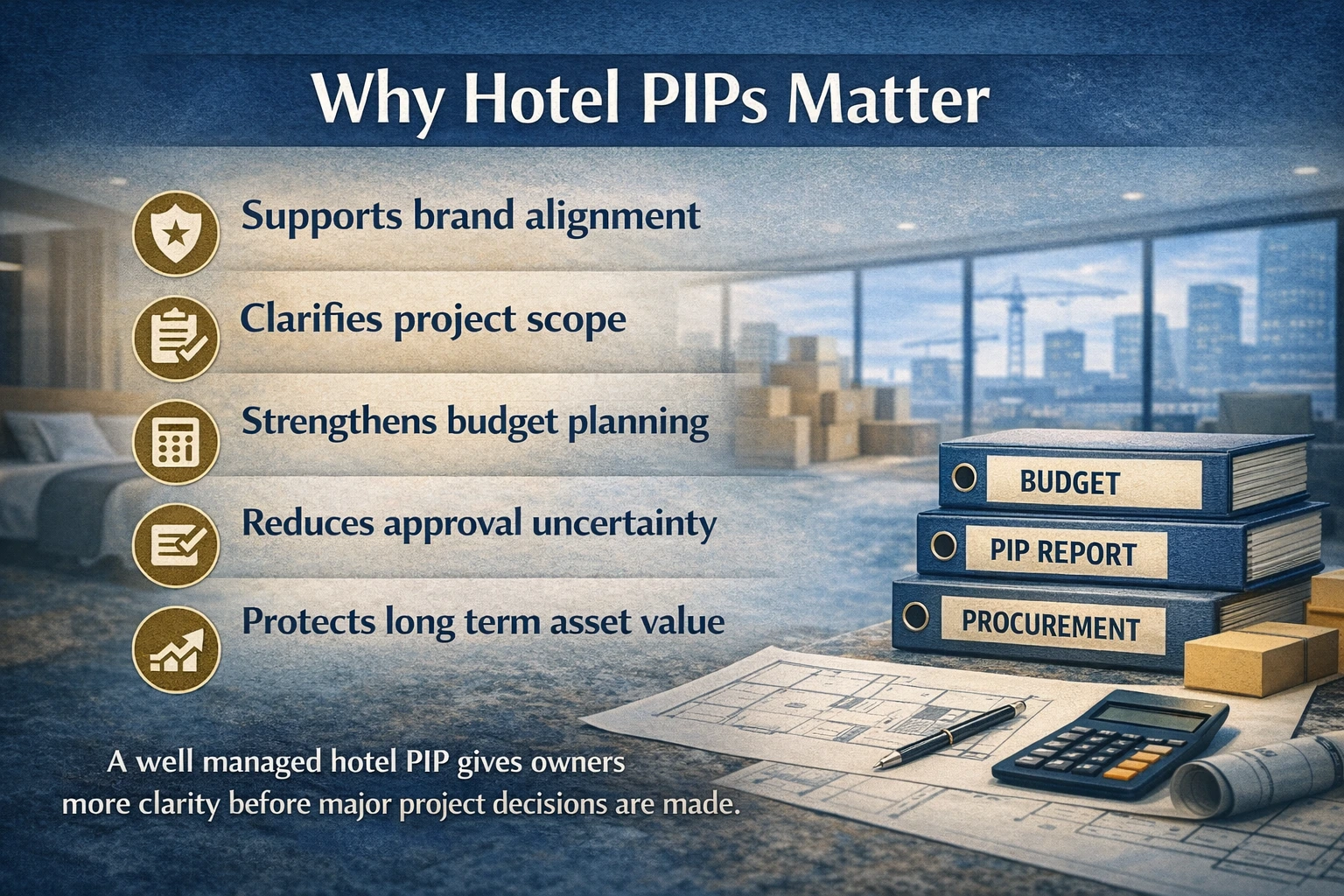
A hotel PIP directly impacts investment planning, property positioning, operational readiness, and long term asset value. It is not just a design exercise. It is a business decision with lasting implications.
When approached strategically, a PIP helps owners:
-
understand the full scope of required improvements
-
align capital planning with realistic project needs
-
prepare for approvals with greater confidence
-
support a consistent guest experience
-
protect long term asset performance
Challenges arise when scope is not fully understood at the beginning. Requirements may be interpreted differently across teams, which can lead to inconsistencies in planning and execution.
This is where early clarity becomes essential.
A structured approach to preliminary budgeting allows owners to establish realistic financial expectations before major decisions are made. Instead of reacting to cost changes later, priorities can be evaluated with greater confidence at the outset.
At the same time, FF&E procurement plays a critical role in aligning design intent, durability expectations, and cost considerations. Many PIP requirements depend on thoughtful sourcing and coordination. When procurement planning happens too late, teams often face compressed timelines and reduced flexibility.
For owners and developers, understanding a hotel PIP early reduces uncertainty and creates a stronger foundation for the decisions that follow.
How Beyer Brown Supports Hotel PIP Execution Through Procurement
A hotel PIP is only as manageable as the process behind it. Once requirements are issued, owners need a structured way to interpret scope, define priorities, align budgets, and move into execution without losing control of the project.
Procurement plays a central role in creating that structure.
Beyer Brown supports hotel PIP execution by helping transform a requirement document into a coordinated project plan. This connects scope, budget, specifications, quantities, procurement timelines, and installation into a clear and manageable process.
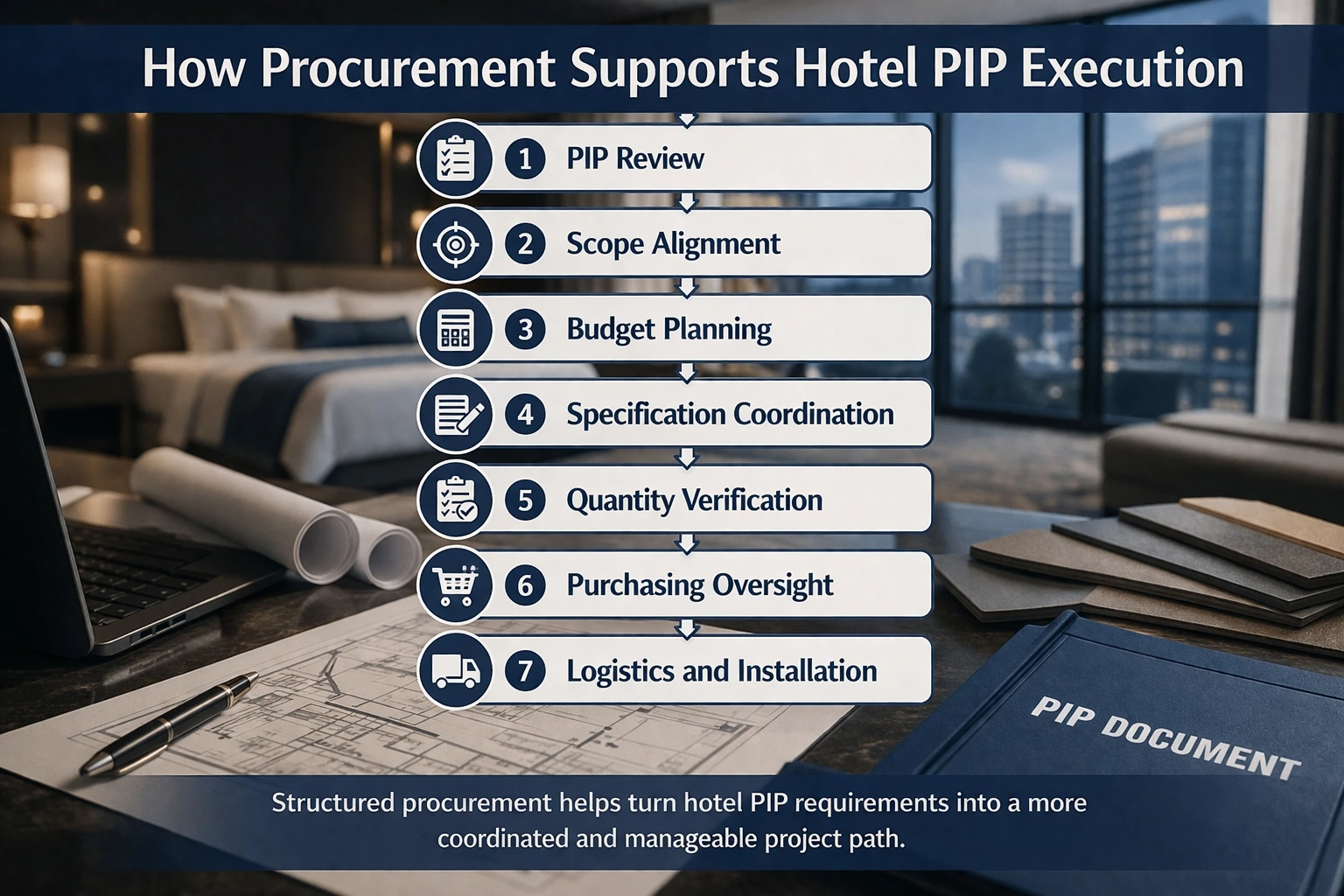
For clients, this creates clarity in several key areas.
First, procurement helps translate the PIP into a workable scope. Some requirements are straightforward, while others impact multiple areas of the property. A disciplined review process helps define what is required, what is priority driven, and what requires further evaluation.
Second, procurement helps align scope with cost. Across hospitality, there is a growing emphasis on evaluating scope and investment together during PIP and acquisition planning. Early cost alignment allows owners to move through approvals with greater confidence and reduces the likelihood of adjustments later in the process.
Third, procurement provides control through specification assistance. Clearly defined product requirements support pricing accuracy, brand alignment, and smoother purchasing decisions.
Fourth, procurement strengthens accuracy through quantity verification. A PIP may define what needs to change, but execution depends on confirming how much is required and how that scope applies across the property.
Finally, procurement supports timeline coordination across purchasing, logistics, and installation. This visibility helps teams anticipate challenges early and maintain project momentum.
The result is a process that feels controlled, aligned, and predictable rather than reactive.
What the Hotel PIP Process Looks Like in Practice
A hotel PIP document is only the starting point. What determines project success is how that document is interpreted and executed.
A well managed hotel PIP typically moves through several connected stages:
PIP Review and Scope Interpretation
The first step is understanding what the PIP is actually requiring. Brand-issued documents may include renovations, replacements, upgrades, compliance items, or operational improvements. Some are clear immediately. Others require interpretation across design, procurement, and project execution.
This review stage establishes what the scope means in practical terms for the property.
Preliminary Budget Development
Once the scope is interpreted, the next step is building a realistic financial picture. This is where owners need more than rough assumptions. They need a budget that reflects actual scope, likely purchasing requirements, and project conditions.
Accurate early planning starts with a realistic financial framework, which is why preliminary budgeting plays such an important role in hotel PIP execution.
Specification Alignment
After budget direction is established, project teams need to define product requirements with clarity. This includes furniture, fixtures, finishes, operational items, and other scope components that must meet design intent and brand expectations.
Clear specifications help reduce ambiguity before purchasing begins, which is why specification alignment is such an important part of a well managed hotel PIP.
Quantity Verification
A hotel PIP may identify what needs to change, but execution still depends on validating quantities. Guest rooms, corridors, public spaces, back of house areas, and amenity zones all need to be reviewed carefully so purchasing reflects actual conditions.
Before procurement moves forward, quantity verification helps ensure the project is aligned with actual property needs rather than assumptions.
Procurement Planning and Purchasing
Once scope, budget, specifications, and quantities are aligned, purchasing can move forward with greater confidence. This phase includes sourcing, vendor coordination, lead time tracking, production oversight, and issue management as needed.
Logistics, Delivery, and Installation Coordination
The final stage is making sure the purchased scope reaches the property in the right sequence and condition. That includes freight planning, warehousing, staging, on site coordination, and installation support.
Each of these phases affects the next. If one stage lacks clarity, the impact often carries through the entire project. A successful hotel PIP depends on managing the full lifecycle, not just the document itself.

The Impact of a Well Managed Hotel PIP
When a hotel PIP is approached with structure, the impact extends across the entire project.
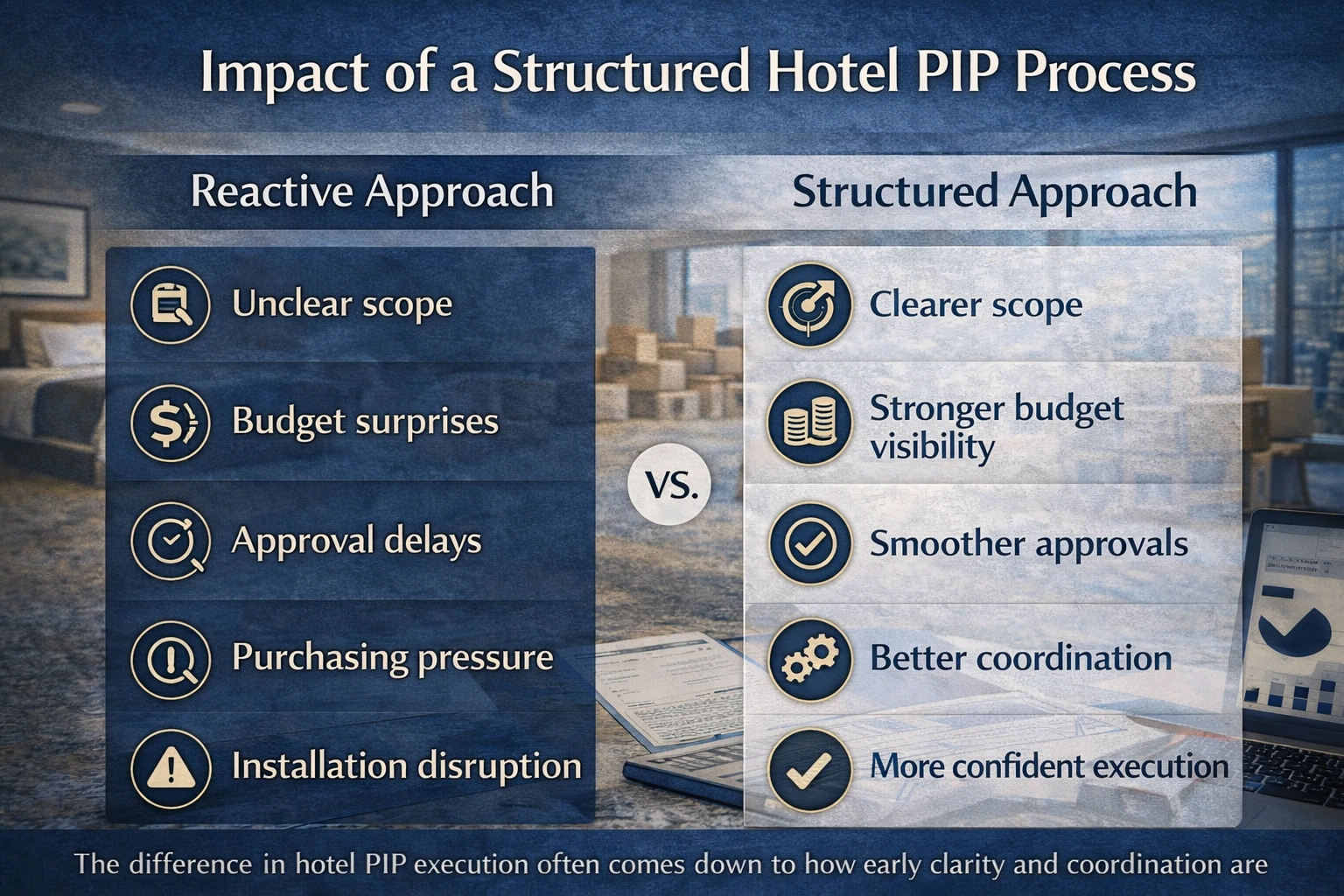
Owners benefit from:
-
clearer budget visibility
-
stronger alignment before approvals
-
more predictable timelines
-
improved coordination across teams
-
better protection of design intent
Projects move forward with fewer disruptions because decisions are made with full visibility and alignment.
In contrast, a reactive approach often leads to:
-
budget discrepancies identified late
-
delays tied to unclear scope
-
increased pressure during purchasing
-
installation challenges that could have been avoided
The difference lies in how the process is managed.
A structured procurement approach creates clarity at every stage. It allows teams to focus on execution rather than problem solving and supports a more controlled project environment.
Why Hotel PIPs Require More Than a Checklist Approach
A hotel PIP is not simply a list of required upgrades. It is a critical moment in the lifecycle of a hospitality asset that affects budget, timeline, approvals, and long term performance.
For owners and developers, the value lies in how the PIP is approached.
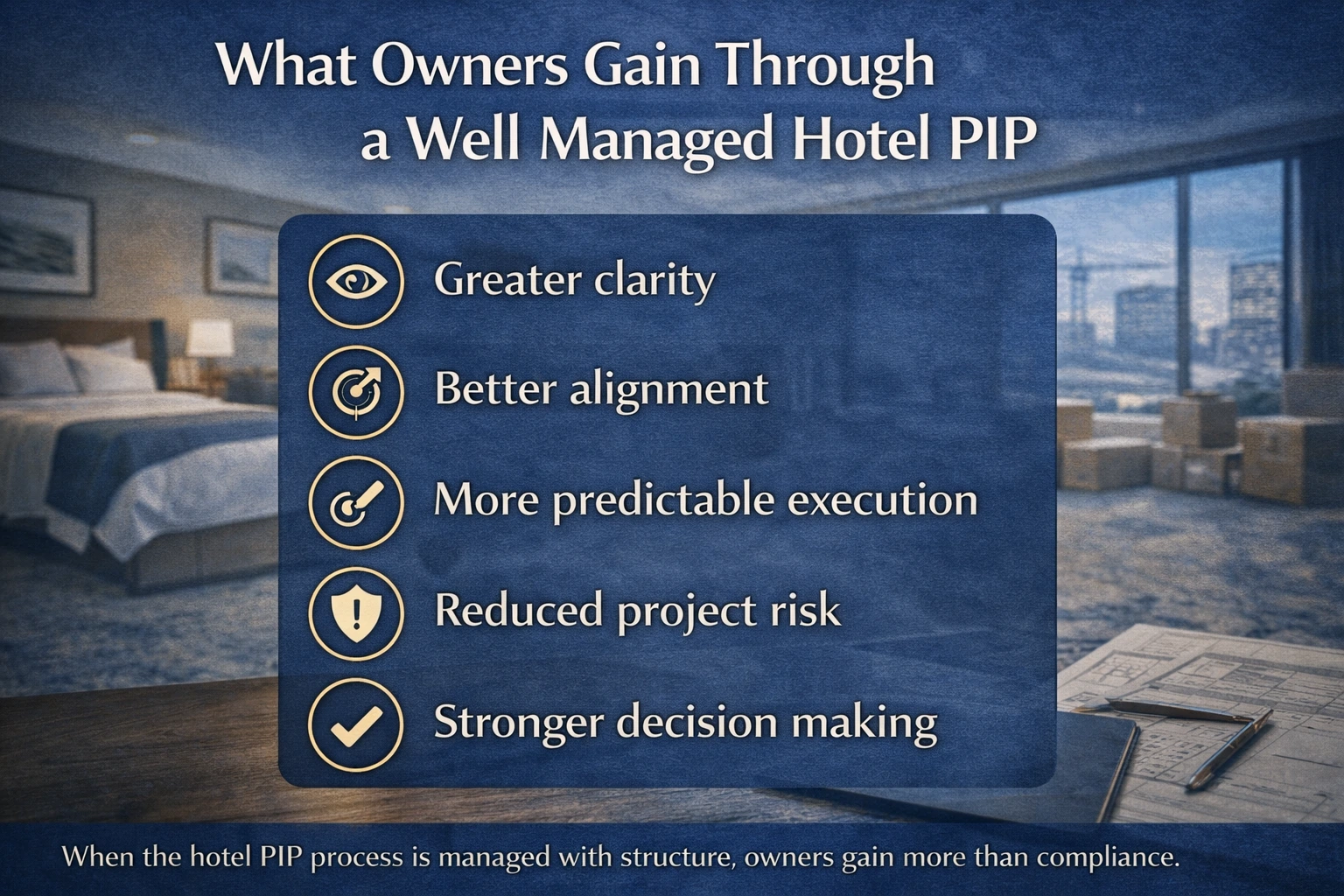
When scope is clearly defined, budgets are aligned early, specifications are documented with precision, and procurement is coordinated thoughtfully, the process becomes more predictable and easier to manage.
This approach reduces uncertainty, supports better decision making, and creates a smoother path through execution.
With the right level of structure, a hotel PIP becomes more than a requirement. It becomes a strategic investment in the future of the property, carried out with clarity and confidence.